
How Often Do You Backwash a Pool?

A pool filter needs backwashing when the tank pressure gauge rises 8 to 10 PSI (the pressure reading on the dial) above its clean baseline, which usually happens every one to two weeks during swimming season. That timing changes based on real dirt buildup rather than a fixed day on the calendar, since running the cycle on a blind schedule wastes water and chemicals.
A few everyday factors shift how quickly that gauge climbs. Heavy rainstorms, windblown leaves, and crowded pool parties pack debris into the tank much faster than quiet weeks. Your equipment type matters as well, because sand and D.E. filters (tanks that use a fine white powder) use a backwash valve, while cartridge systems must be opened up and rinsed by hand. Understanding what your specific filter needs will keep your water crystal clear and protect your pump.
Reading Your Pressure Gauge Instead of the Calendar
The safest way to know when to backwash is by checking your tank pressure gauge (the small round dial on top of your filter that shows water resistance). Every pool filter has a clean baseline pressure. This baseline is the PSI (pressure reading on your tank gauge) when the filter media is completely clean and water flows freely through the system.
For most backyard pools, a clean baseline sits somewhere between 10 and 15 PSI. However, your clean number depends on your pipe size, pump horsepower, and plumbing distance. Check your gauge immediately after a fresh cleaning, and write that starting number down on the tank with a permanent marker. Your trigger to backwash is when the gauge rises 8 to 10 PSI above that starting mark.
Relying on a strict calendar habit often causes trouble. Some pool owners backwash every Saturday morning because someone told them to do it weekly. If your pool has stayed clean, that weekly wash flushes away clean water and costly chemicals for no reason. On the other hand, if a windstorm blows dirt into the water on Tuesday, waiting until Saturday can choke your pump and leave your pool cloudy for days. Let the needle on the gauge tell you when the filter is full.
During the quiet weeks of late spring, your gauge might stay in the safe zone for two or three weeks without climbing. In the peak of July, heavy swimming and warm water might push your pressure up every seven to ten days. Watching the needle removes the guesswork and saves your equipment from unnecessary strain.
Surprise Moments That Require an Early Filter Clean
While the pressure gauge is your main guide, certain pool events pack your filter with debris long before your regular routine calls for a wash. When these situations happen, check your gauge daily and prepare to backwash early.
- Severe rain and windstorms: Strong storms wash garden soil, pollen, and lawn mulch straight into your pool water. This fine debris collects in your sand or powder beds within hours, causing a sudden spike in tank pressure.
- Treating an algae bloom: When you kill off an algae outbreak, the dead plant matter turns into a grayish, powdery sludge. As your pump pulls this sludge out of the water, it blankets the filter and stops water flow fast. If you are balancing chemicals during an outbreak, reviewing how much bleach to add to pool water helps clear the water without overwhelming your filter all at once.
- Opening your pool in spring: The first few days of seasonal startup pull months of settled dirt, decaying leaves, and fine silt out of the water. Your filter might need two or three backwashes in the first forty-eight hours alone.
- Vacuuming heavy debris from the floor: If you manually vacuum fine silt or dust through your skimmer line, that dirt goes directly into the filter tank rather than settling into a leaf basket. Expect your pressure to climb immediately after you finish.
- Noticeable drop in wall jet power: If the clean water returning to your pool from the wall fittings feels weak or barely ripples the surface, water cannot push through the tank. Even if your gauge is stuck or broken, weak return flow is a clear physical warning sign.
Step-by-Step: The Safe Way to Backwash Your Filter
Backwashing reverses the water flow through your filter tank to lift, loosen, and flush out trapped dirt through a waste line. Follow these exact steps to clean the system safely without damaging your plumbing.
- Shut off the pool pump completely.
Reason: Moving the multiport valve (the handle on your filter tank that changes where water flows) while the pump runs will rip the internal rubber gasket and cause permanent water leaks.
- Unroll your discharge hose and inspect the run.
Reason: Kinks, sharp bends, or twists in the lay-flat hose build up dangerous pressure that can burst the vinyl and flood your equipment pad or flowerbeds.
- Press down and rotate the valve handle to "Backwash".
Reason: Pushing the handle all the way down clears internal plastic ridges so you do not strip the diverter mechanism inside the valve body.
- Turn the pump on and watch the sight glass.
Reason: The sight glass (a small clear plastic tube on the valve side) lets you see the dirty water leaving the tank, which starts out cloudy, brown, or green before clearing up.
- Run the pump until the sight glass water runs clear, usually two minutes.
Reason: Running it less than ninety seconds leaves trapped dirt inside the tank, while running it longer than three minutes wastes hundreds of gallons of pool water.
- Turn the pump off and switch the valve handle to "Rinse".
Reason: The rinse cycle (a setting that packs sand down before normal use) flushes lingering dirt out the waste line rather than blowing a cloud of grime back into your clean swimming pool.
- Turn the pump on for thirty to sixty seconds in rinse mode.
Reason: This short cycle resettles the loose sand bed firmly into place so it is ready to trap dirt particles efficiently again.
- Turn the pump off, set the valve handle back to "Filter", and restart.
Reason: Returning to normal circulation mode restores regular filtration and lets you take an accurate pressure reading.
- Check your pressure gauge and refill lost pool water.
Reason: Your gauge should now read at your original clean baseline, and checking the pool water level ensures your skimmer does not suck in air and run dry.
Why Backwashing Too Often Causes Cloudy Pool Water
It sounds backward, but a sand filter actually traps tiny dust particles better when it is slightly dirty. Fresh, brand-new sand grains are smooth and have small gaps between them. As your pool runs, larger pieces of dirt get trapped in those gaps. That trapped dirt creates a tighter mesh that catches smaller particles like dust, pollen, and body oils.
When you backwash every few days on a rigid schedule, you break apart that natural filtering layer. The sand stays loose and open, allowing microscopic dust to slip right past the sand bed and blow straight back into your swimming pool. Over-washing often results in water that stays dull or hazy no matter how many balancing chemicals you pour into the pool.
Frequent backwashing also dumps hundreds of gallons of heated, treated water down the drain each month. Every time you drain water to clean the filter, you lose pool stabilizer, salt, and sanitizer. You then have to add fresh tap water, which changes your water balance and forces you to buy more balancing chemicals. Trust your pressure gauge, let the filter do its job, and only wash the media when that 8 to 10 PSI rise tells you the tank is full.
How Sand, D.E., and Cartridge Filters Change the Rules
The rules for cleaning your filter depend on the media inside your tank. Using the wrong routine on the wrong filter type can ruin your equipment or dump dirty media into your yard.
Sand filters are the most common systems that use a regular backwash cycle. They hold several hundred pounds of special pool-grade silica sand. You backwash them according to your pressure gauge, run a quick rinse to settle the bed, and resume swimming. The sand inside stays in the tank for five to seven years before the rough edges wear down and need replacement.
D.E. filters (systems that use diatomaceous earth, a white powder inside certain filters that must be replaced after backwashing) trap much smaller dirt particles than sand. When you backwash a D.E. filter, the white powder washes away along with all the trapped dirt. Because of this, you must mix fresh powder with water and pour it through your pool skimmer immediately after every backwash. If you forget to add new powder, dirt will cake directly onto the internal fabric grids and ruin them.
Cartridge filters are entirely different: they do not have a multiport valve and must never be backwashed. If you own an above-ground pool setup, such as learning how long seasonal pools hold up over several summers, your equipment pad likely features one of these cartridge tanks. A cartridge filter contains a pleated polyester element inside the tank. When the pressure gauge rises 8 to 10 PSI on a cartridge system, you turn off the pump, open the air relief valve, take the tank lid off, pull out the cartridge, and spray the pleats clean with a regular garden hose.
Managing Dirty Wastewater with a Heavy-Duty Discharge Hose
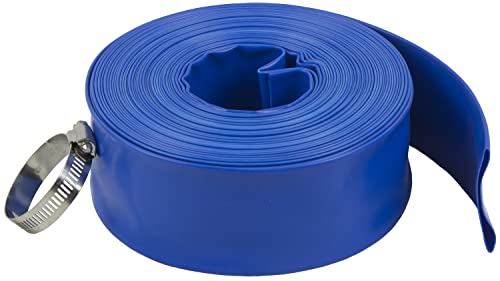
When you switch your filter to clean mode, your pool pump pushes water out of the waste port at high speed. Directing that rush of dirty water requires a reliable discharge hose (a flexible lay-flat hose that connects to your filter waste pipe to guide runoff away from your house).
A good backwash hose rolls out flat when water flows through it and rolls back up tightly for easy storage between cleanings. Look for a hose made from reinforced PVC material lined with polyester yarn. Standard thin vinyl hoses tend to crack under pressure, tear on rough concrete pads, or split open when water rushes around a corner. A reinforced wall prevents surprise leaks that can wash away garden soil or flood your patio.
Before selecting a hose, check the exact size of your filter waste port. Most pool filter valves use either a 1.5-inch or a 2-inch pipe connection. Measure your fitting carefully, and secure the hose using a stainless steel clamp so the water pressure does not knock the hose loose. Pick a length that carries wastewater well past your pool foundation, equipment pad, and flowerbeds to a safe drainage spot approved by your local town guidelines.

- VC Score9.4
BCP Score is a ranking system developed by bestcleanerproducts.com. BCP Score has no relationship or impact from any manufacturers or sales agent websites. Learn more
- BrandLEBLEBALL

- VC Score9.4
BCP Score is a ranking system developed by bestcleanerproducts.com. BCP Score has no relationship or impact from any manufacturers or sales agent websites. Learn more
- BrandPentair

- VC Score9.2
BCP Score is a ranking system developed by bestcleanerproducts.com. BCP Score has no relationship or impact from any manufacturers or sales agent websites. Learn more
- BrandWHAT DO YOU MEME?

- VC Score9.2
BCP Score is a ranking system developed by bestcleanerproducts.com. BCP Score has no relationship or impact from any manufacturers or sales agent websites. Learn more
- BrandPoolzilla

- VC Score9.0
BCP Score is a ranking system developed by bestcleanerproducts.com. BCP Score has no relationship or impact from any manufacturers or sales agent websites. Learn more
- BrandGonioa

- VC Score9.0
BCP Score is a ranking system developed by bestcleanerproducts.com. BCP Score has no relationship or impact from any manufacturers or sales agent websites. Learn more
- BrandSwimline

- VC Score8.8
BCP Score is a ranking system developed by bestcleanerproducts.com. BCP Score has no relationship or impact from any manufacturers or sales agent websites. Learn more
- BrandBlue Devil
- VC Score8.6
BCP Score is a ranking system developed by bestcleanerproducts.com. BCP Score has no relationship or impact from any manufacturers or sales agent websites. Learn more
- BrandPoolmaster

- VC Score8.4
BCP Score is a ranking system developed by bestcleanerproducts.com. BCP Score has no relationship or impact from any manufacturers or sales agent websites. Learn more
- BrandSuisvars

- VC Score8.2
BCP Score is a ranking system developed by bestcleanerproducts.com. BCP Score has no relationship or impact from any manufacturers or sales agent websites. Learn more
- BrandSET SUNSOLAR ENERGY TECHNOLOGIES

- VC Score8.0
BCP Score is a ranking system developed by bestcleanerproducts.com. BCP Score has no relationship or impact from any manufacturers or sales agent websites. Learn more
- BrandSwimline

- VC Score7.4
BCP Score is a ranking system developed by bestcleanerproducts.com. BCP Score has no relationship or impact from any manufacturers or sales agent websites. Learn more
- BrandAulock
Last update on 2026-10-08 / Affiliate links / Images, Product Titles, and Product Highlights from Amazon Product Advertising API
Frequently Asked Questions
How long should my backwash cycle run?
Most sand and powder filters need between two and three minutes of backwashing. Watch the clear sight glass on the side of your valve handle as the pump runs. As soon as the cloudy, discolored water turns crystal clear, shut the pump off so you do not waste water.
Can I drain pool backwash water directly onto my grass?
Draining pool water directly onto your lawn can harm grass and delicate plants if chlorine or salt levels are high. It is safer to direct the runoff into a designated dry well, cleanout port, or gravel drainage ditch. Always check local town rules, as many areas ban draining pool water into municipal storm drains.
Why is my filter pressure still high right after backwashing?
If your pressure gauge stays high after a thorough wash, your filter media may be clogged with body oils, suntan lotions, or mineral scale that water flow cannot dislodge. Sand may need a specialized chemical soak or full replacement, while D.E. grids may need to be disassembled and soaked in a cleaning solution. A faulty gauge that stays stuck above zero when the pump is completely off also causes false high readings.
Do I have to turn the pool pump off every time I move the valve handle?
Yes, always turn the pump power off before touching the multiport valve handle. Moving the valve while water rushes through tears the internal spider gasket, a shaped rubber seal that keeps clean and dirty water separated. A torn gasket allows dirty pool water to leak continuously back into your pool or out through your waste line.


How to Refinish a Fiberglass Pool

How Do You Keep Raccoons Out of Your Pool?

How to Fix Cyanuric Acid in Your Pool

How to Shape a Pool Cue Tip to Stop Miscues

12 Best Automatic Vacuum For Intex Above Ground Pool of 2026 To Keep Vinyl Floors Spotless

10 Best Automatic Pool Vacuum For Above Ground Pool of 2026 To End Manual Scrubbing

How Much Pool Clarifier Should You Use for Your Pool Size?

How Much Does a Pebble Tec Pool Cost to Build or Resurface?


