
How Much DE Powder Does Your Pool Filter Need?

A homeowner stands beside the humming pump with a puff of chalky dust rising from an open bag. The standard rule is to use one pound of powder for every ten square feet of filter area. That protective layer keeps dirt from grinding into the fabric frames inside the tank without blowing a milky cloud straight into the pool.
That starting number shifts depending on the job at hand. A fresh clean after taking the tank apart requires a full dose, but a routine backwash leaves leftover powder behind, meaning the filter only needs eighty percent of the original amount. The total size stamped on the equipment label also dictates the math, and regular plastic scoops measure volume instead of true scale weight. Here is how to calculate the right dose for your setup and add it without any mess.
The Short Version
- Use 1 pound of diatomaceous earth (a fine white mineral powder) for every 10 square feet of filter area if your tank is completely empty after an annual deep clean.
- Add only 80 percent of that amount after a backwash (running water in reverse to flush dirty powder), because some residual powder always clings to the fabric inside.
- Confirm the size of your unit by checking the model number on the side of your tank before measuring.
- Always mix the powder with pool water in a bucket before pouring it slowly into your skimmer while the pump is running.
The Standard DE Filter Powder Formula
Diatomaceous earth filters rely on a simple mathematical rule to work properly. You need 1 pound of powder for every 10 square feet of internal grid area. The fabric frames inside your tank do not filter water on their own. Instead, they act as a support frame for the fine white mineral powder, which coats the fabric and traps microscopic debris down to just a few microns.
When you take your filter apart, hose down the parts completely, and reassemble everything dry, you start at zero. In that scenario, you apply the full formula. For example, a 48-square-foot unit requires 4.8 pounds of powder, while a 60-square-foot unit requires a flat 6 pounds. Much like figuring out how much sand a pool filter needs, putting the wrong volume of media into the tank causes immediate circulation problems.
The calculation changes after a standard backwash. Running water backward flushes out the bulk of the trapped dirt, but it never strips all the caked powder off the fabric frames. Roughly 20 percent of the old powder stays trapped in the fabric folds. If you add the full original dose after backwashing, your tank will become overpacked. Because of this, always use the 80 percent rule after backwashing. Multiply your full clean dose by 0.8 to find your working target.
- 24 sq. ft. filter: 2.4 pounds after a deep clean, or 1.9 pounds after backwashing.
- 36 sq. ft. filter: 3.6 pounds after a deep clean, or 2.9 pounds after backwashing.
- 48 sq. ft. filter: 4.8 pounds after a deep clean, or 3.8 pounds after backwashing.
- 60 sq. ft. filter: 6.0 pounds after a deep clean, or 4.8 pounds after backwashing.
- 72 sq. ft. filter: 7.2 pounds after a deep clean, or 5.75 pounds after backwashing.
Following these specific numbers protects your pump motor from working against unnatural resistance. It also ensures water flows evenly across every square inch of internal fabric.
How to Find Your Pool Filter Size
You cannot guess your filter area based on the size of your swimming pool. A small pool can easily have a large filter tank, and a large pool might use a medium-sized unit running on longer daily cycles. You need to inspect the equipment pad directly.
Look at the silver or white manufacturer decal on the curved belly of the tank. The total surface area is usually printed clearly in square feet. If sunlight has faded the label, look closely for the stamped model number. Most major manufacturers embed the exact square footage directly into that sequence of letters and numbers.
For example, a Hayward Pro-Grid model stamped DE4820 has 48 square feet of area. A model marked DE6020 has 60 square feet. A Pentair FNS Plus 36 contains 36 square feet, while a Pentair FNS Plus 60 contains 60 square feet. The two digits right in the middle or at the end almost always point directly to the square footage.
If the label is completely unreadable, turn off the pump, relieve the internal pressure, and remove the tank belly clamp. Take out one of the internal fabric grids and measure its vertical height with a tape measure. Standard curved grids typically measure 18 inches, 24 inches, 30 inches, or 36 inches in length. A 24-inch grid height usually indicates a 48-square-foot tank, while a 30-inch grid height generally points to a 60-square-foot tank. You can confirm the measurement against your brand parts diagram online.
Measuring DE: Scoops Versus Actual Pounds
One of the most common mistakes pool owners make is grabbing a kitchen scale or an old coffee container. Diatomaceous earth is extremely fluffy and aerated. It does not share the same weight-to-volume ratio as water, sand, or kitchen baking ingredients.
A standard plastic pool DE scoop measures volume rather than scale weight. When you fill an official pool scoop level to the brim, it holds the exact volume that equals 1 pound of settled powder. However, if you weigh that same scoop on a digital kitchen scale, it might read between 0.8 and 1.1 pounds depending on how tightly packed the dust is in your bag. The pool industry designed these plastic scoops specifically so you do not have to haul an electric scale outside to your equipment pad.
Do not substitute a 1-pound metal coffee can for an official pool scoop. A coffee can holds much less powder by weight because ground coffee is significantly denser than aerated mineral dust. If you use a coffee can to count out six scoops, you will severely undercoat your filter. Invest in a dedicated plastic pool scoop from your local pool supply store, or weigh your bucket on a bathroom scale before adding it to the pool.
Keep your measuring scoop dry between uses. Storing a damp scoop inside your powder bag causes the fine dust to bind together into solid chalky pebbles. Those hardened chunks will settle in your plumbing pipes instead of dissolving and coating your fabric frames.
How to Add DE Powder to Your Skimmer Step by Step
Adding powder requires a careful routine. Dumping dry powder straight into an open skimmer throat will cause an immediate clog in your underground suction pipe. Follow this process every time you recharge the system.
- Put on protective gear: Diatomaceous earth is a very fine silica powder that can irritate your respiratory system and dry out your skin. Wear a basic dust mask and safety glasses before opening the storage bag, especially on breezy afternoons.
- Check your pump and water flow: Turn on your pool pump and make sure water is moving at full operating speed. If your plumbing system features multiple suction valves, adjust them so the skimmer you plan to use has strong suction. Make sure nobody is swimming while you service the pool equipment.
- Vent trapped air from the tank: Find the air relief valve (a small knob on top of the tank to vent trapped air). Turn the knob counterclockwise until you hear hissing air escaping. Once a steady stream of solid water shoots out of the valve, close the knob tightly.
- Mix a bucket slurry: Fill a clean 5-gallon bucket about halfway with fresh pool water. Add your measured scoops of powder into the bucket one by one. Use a wooden stick or plastic paddle to stir the mixture until it turns into a smooth, milky slurry (powder stirred into a bucket of water).
- Pour slowly into the skimmer: Remove the skimmer lid and basket. Pour the slurry directly into the skimmer opening in a slow, steady stream. Take about 60 to 90 seconds to empty the entire bucket. This controlled pace allows the pool pump to sweep the mineral particles down the suction line without gathering into a thick mass.
- Let the circulation system run: Keep your pool pump running continuously for at least two hours after adding the slurry. The continuous water flow presses the powder against the filter grids (fabric frames inside the tank that catch dirt), creating a smooth, protective cake over the entire assembly.
- Record your clean baseline pressure: Once the water has circulated for two hours, look at the round pressure gauge mounted on your filter tank. Take note of the exact number, which is usually between 8 and 15 pounds per square inch. Write this number down with a permanent marker directly on the tank. This is your clean starting baseline.
While you are tending to your equipment pad, remember to check your broader water chemistry balance. Keeping your sanitizer stable with regular adjustments, just as you would monitor how many chlorine tablets to use in a pool, prevents algae blooms from choking your newly coated filter grids prematurely.
Signs You Used Too Much or Too Little DE
An incorrect amount of powder quickly reveals itself through abnormal water flow, unusual gauge readings, or physical debris appearing in the swimming pool. Learning how to read these warning signs will prevent costly equipment repairs.
If you add too little powder, your water will slowly turn hazy and refuse to clear up. More importantly, dirty pool water will push fine silt, algae spores, and body oils straight into the raw woven fabric of your internal frames. Once greasy dirt embeds itself directly into those bare pores without a protective powder barrier, no amount of backwashing can clean it out. The fabric clogs permanently, and you will have to soak the frames in specialized chemical baths or buy expensive replacements.
Adding too much powder creates a completely different set of problems. The most immediate sign is an abnormal spike on your pressure gauge. If your clean baseline is usually 10 pounds per square inch, but the gauge jumps straight to 20 pounds per square inch right after you pour your slurry, you added too much media. The extra powder packs the spaces between the frames completely solid, a problem known as bridging.
Bridging restricts the flow of water so severely that it strains your pump motor and can crack the internal plastic manifolds that hold the frames together. Another clear sign of overfilling is a dusty white cloud blowing out of your return jets back into the pool. When the tank interior runs out of room to hold the powder, the excess mineral dust bypasses the seals and settles on your pool floor like a layer of chalk.
If you notice cloudy white powder accumulating on the bottom of your pool, turn off the pump immediately. Inspect your internal parts for a torn fabric sleeve, a cracked manifold, or a dislodged internal air bleed tube before running the system again.
Choosing the Right Filter Powder and Maintenance Tools
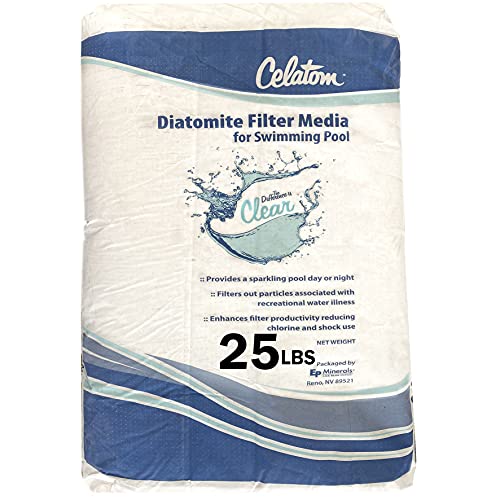
Keeping a diatomaceous earth system running smoothly requires using the right grade of media and basic maintenance tools. When shopping for replacement powder, always confirm that the bag is clearly marked for swimming pool and spa use. Pool-grade powder is heat-treated to give the microscopic skeletons the specific shape needed to trap fine pool dirt. Never use garden-grade or food-grade diatomaceous earth in a swimming pool; those natural varieties lack the structural properties needed for water filtration and will immediately turn your pool milky.
Most pool owners find that buying powder in 25-pound bags offers the best balance of value and ease of handling. A single 25-pound bag typically covers an entire swimming season for an average residential pool, providing enough media for an initial spring charge and several backwash cycles throughout the summer.
Beyond the powder itself, keeping a few dedicated tools at your equipment pad makes the job significantly easier. A durable, calibrated plastic scoop prevents dosing errors and protects you from overfilling the tank. When it comes time for your annual deep clean, a specialized curved cleaning wand that attaches to your garden hose helps flush compacted debris out of deep fabric folds without puncturing the delicate material.
Inspect your fabric frames and top plastic manifolds once a year for hairline cracks or fraying seams. Replacing worn internal parts before the swimming season begins ensures your powder stays locked safely inside the tank where it belongs.

- VC Score9.6
BCP Score is a ranking system developed by bestcleanerproducts.com. BCP Score has no relationship or impact from any manufacturers or sales agent websites. Learn more
- BrandYougfin

- VC Score9.6
BCP Score is a ranking system developed by bestcleanerproducts.com. BCP Score has no relationship or impact from any manufacturers or sales agent websites. Learn more
- BrandTier1
- VC Score9.4
BCP Score is a ranking system developed by bestcleanerproducts.com. BCP Score has no relationship or impact from any manufacturers or sales agent websites. Learn more
- BrandEasyGo Product

- VC Score9.0
BCP Score is a ranking system developed by bestcleanerproducts.com. BCP Score has no relationship or impact from any manufacturers or sales agent websites. Learn more
- BrandMOLVCE

- VC Score9.0
BCP Score is a ranking system developed by bestcleanerproducts.com. BCP Score has no relationship or impact from any manufacturers or sales agent websites. Learn more
- BrandHANXER

- VC Score9.0
BCP Score is a ranking system developed by bestcleanerproducts.com. BCP Score has no relationship or impact from any manufacturers or sales agent websites. Learn more
- BrandZOTEE

- VC Score8.6
BCP Score is a ranking system developed by bestcleanerproducts.com. BCP Score has no relationship or impact from any manufacturers or sales agent websites. Learn more
- BrandHANXER

- VC Score8.0
BCP Score is a ranking system developed by bestcleanerproducts.com. BCP Score has no relationship or impact from any manufacturers or sales agent websites. Learn more
- BrandU.S. Pool Supply

- VC Score7.8
BCP Score is a ranking system developed by bestcleanerproducts.com. BCP Score has no relationship or impact from any manufacturers or sales agent websites. Learn more
- BrandSavener
Last update on 2026-10-08 / Affiliate links / Images, Product Titles, and Product Highlights from Amazon Product Advertising API
FAQs
Can I run my pool filter without DE powder?
No, you should never run your pool pump without powder in the filter tank. The internal fabric grids are only designed to hold the powder in place, not to filter dirt on their own. Running water without powder will force dirt and oils directly into the fabric pores, ruining the frames within a few hours.
How often do I need to add more DE to my filter?
You only need to add powder after you have backwashed the system or opened the tank for a full physical cleaning. Under normal conditions, you do not add powder on a weekly or daily schedule. Watch your pressure gauge, and when it rises 8 to 10 pounds per square inch above your clean baseline, backwash the tank and recharge the powder.
Why is white powder blowing back into my pool after adding DE?
White powder returning into the pool almost always means there is a physical opening inside your filter tank. This happens when a fabric grid has a small tear, the top plastic manifold is cracked, or an internal O-ring seal is missing. Turn off the pump, open the tank, and inspect every grid carefully for tiny holes or separated seams.
Is diatomaceous earth safe to breathe while adding it?
Breathing pool-grade diatomaceous earth dust can irritate your lungs, throat, and nasal passages because it contains fine crystalline silica. You should always wear a basic dust mask or respirator when handling dry powder, especially when pouring it into a measuring bucket on windy days. Mixing the powder into a water slurry immediately reduces airborne dust and keeps your work area safe.


How to Refinish a Fiberglass Pool

How Do You Keep Raccoons Out of Your Pool?

How to Fix Cyanuric Acid in Your Pool

How to Shape a Pool Cue Tip to Stop Miscues

12 Best Automatic Vacuum For Intex Above Ground Pool of 2026 To Keep Vinyl Floors Spotless

10 Best Automatic Pool Vacuum For Above Ground Pool of 2026 To End Manual Scrubbing

How Much Pool Clarifier Should You Use for Your Pool Size?

How Much Does a Pebble Tec Pool Cost to Build or Resurface?








