
How Long Does It Take to Fill an 8000 Gallon Pool?

Plan on 18 to 22 hours. A standard outdoor spigot pushes five to ten gallons of water each minute through an ordinary garden hose. At that flow rate, filling an 8,000-gallon pool takes between 13 and 27 hours, which means your tap will run for almost a full day.
That wait time shifts depending on your outdoor setup. A wide, short garden hose delivers water much faster than a long, narrow hose dragged across the lawn. Hooking up a second hose on a separate line can cut hours off the job, but households on private well water need to pace the flow so the pump does not run dry. Here is how to calculate your exact fill time and protect your yard while the water rises.
Most Hoses Fill 8000 Gallons in 13 to 27 Hours
How quickly your pool fills depends almost entirely on water flow rate, commonly measured as GPM (gallons per minute). A standard outdoor household spigot typically delivers between 5 and 10 gallons per minute. At the slower rate of 5 GPM, an 8,000-gallon pool takes around 26 to 27 hours of steady running. At a faster flow rate of 10 GPM, that same fill finishes in just over 13 hours.
Most residential homes land right in the middle, averaging between 6 and 7 GPM. That puts your expected waiting time between 19 and 22 hours with a single hose. If you turn on your spigot at eight o'clock in the morning, you can expect the water to reach swimming depth early the following morning.
Here is how the timeline breaks down at different common household flow rates:
- 5 GPM (low pressure or long hose): 26 hours and 40 minutes
- 6 GPM (average residential spigot): 22 hours and 15 minutes
- 7 GPM (strong residential flow): 19 hours
- 8 GPM (high municipal pressure): 16 hours and 40 minutes
- 10 GPM (high-capacity line with short hose): 13 hours and 20 minutes
Your actual speed depends on hose hardware and household water pressure. A garden hose with a 1/2-inch inside diameter restricts flow far more than a 5/8-inch or 3/4-inch hose. Even if your spigot has great pressure, forcing water through a narrow or extra-long 100-foot hose creates internal friction that drops your GPM significantly.
Indoor water use also robs your outdoor hose of pressure throughout the day. Running washing machines, taking long showers, or running lawn sprinklers while the pool is filling lowers the spigot output. To keep the timeline on track, try to postpone heavy laundry loads and lawn irrigation until the pool is completely full.
A 5-Gallon Bucket Pinpoints Your Exact Finish Time
You do not have to guess how many gallons your spigot pushes each minute. You can find your exact fill rate in less than two minutes using a standard bucket and your phone. Knowing your real flow rate removes the guesswork and tells you exactly when to shut off the spigot.
- Grab a 5-gallon bucket and a stopwatch. Use a clean utility bucket with an exact 5-gallon mark. Open the timer app on your phone so you are ready to time the flow to the second.
- Connect your actual pool-filling hose. Do not check the spigot directly. You need to measure the water coming out of the end of the garden hose you plan to use, including any attachments, because the hose length changes the flow rate.
- Turn the outdoor spigot all the way open. Point the hose away for a few seconds until the water flows at full, steady force without spitting trapped air.
- Time the fill precisely. Direct the hose into the bucket and start your stopwatch the moment water hits the bottom. Stop the timer the instant the water level hits the 5-gallon line.
- Calculate your gallons per minute. Divide 300 by the number of seconds it took to fill the bucket. For example, if filling your 5-gallon bucket took 45 seconds, divide 300 by 45, which equals 6.66 GPM.
- Find your total fill hours. Divide 8,000 gallons by your GPM, then divide that result by 60 minutes. Using the 6.66 GPM example, 8,000 divided by 6.66 equals roughly 1,201 minutes. Dividing 1,201 by 60 gives you just about 20 hours of total run time.
Make sure nobody inside the house turns on a sink or flushes a toilet while you run this check. Measuring your water flow during a period of normal, quiet household water use gives you the most reliable calculation.
Two Hoses Cut Time but Can Strain Private Wells
Hooking up two garden hoses sounds like an easy way to cut your fill time down to 10 hours, but how you connect them matters. Screwing a simple brass Y-splitter onto a single outdoor spigot rarely doubles your speed. Because the pipe feeding that single spigot has a limited diameter, splitting the outlet usually only boosts your total water delivery by 10 to 15 percent.
To cut your fill time in half, you must run hoses from two completely separate spigots located on different sides of your home. These spigots draw from separate interior plumbing branches, allowing both hoses to operate near their maximum capacity. When running two separate lines, an 8,000-gallon pool can easily fill in 9 to 11 hours on city water.
If your home uses a private well instead of municipal city water, running two hoses at once creates serious risks. Private well systems rely on an underground water table and a recovery rate, which is the speed at which groundwater refills your well casing. Most residential wells produce between 3 and 7 gallons per minute in sustained yield.
Drawing water continuously for 15 to 20 hours can pull down your water table faster than the ground can replenish it. When the water level in the well drops below the pump intake, the pump begins pulling in air. This problem causes pump cavitation (the pump running dry without enough water), which overheats the motor, wears out the internal impellers, and can ruin an expensive deep-well pump in a matter of hours.
Well owners should always fill an 8,000-gallon pool in stages rather than one continuous run. Run the hose for two to three hours, then shut the spigot off completely for two hours to give your underground aquifer time to recover. Cycling your fill this way stretches the calendar time out to two or three days, but it prevents your well from running dry and protects your household drinking water.
Running a hose overnight is generally fine on reliable city water, provided you confirm your math with the bucket check first. If you calculate an 18-hour fill and start at noon, the pool will reach full depth around six o'clock the next morning. However, if your timeline points to the pool finishing at three in the morning, shut the water off before going to bed. An unattended overflow can quickly saturate the ground beneath an above-ground pool frame, leading to shifted structural supports or yard erosion.
Watch Liner Wrinkles and Ground Settling as Water Rises
Filling an 8,000-gallon pool is not a completely passive chore. As the water level creeps upward, thousands of pounds of pressure settle onto the floor and frame. Checking the pool at specific water depths lets you catch small structural problems before the weight makes them impossible to fix.
- At 1 to 2 inches of water: Check the liner (the vinyl pool floor and wall sheet). This shallow depth is your only opportunity to smooth out floor wrinkles. Step into the pool barefoot and gently kick or push the vinyl wrinkles toward the outside walls. Once the pool holds more than 3 or 4 inches of water, the weight of the water locks the vinyl in place, and you will not be able to budge the wrinkles without draining the pool.
- At 6 inches of water: Check the pool frame for levelness and inspect the vertical support legs. The ground must support over 66,000 pounds when the pool is completely full. Confirm that none of the bottom support plates or patio blocks are sinking into mud. If one side of the pool is more than an inch lower than the other, stop the hose immediately, as an off-level pool can buckle its walls under full load.
- At 2 feet of water: Inspect the perimeter outside the pool. Look for damp patches or pooling water caused by leaking hose connections or small punctures in the vinyl. Verify that the bottom wall seam looks smooth and centered around the bottom track.
- At the midpoint of the skimmer: Shut off the water when the level reaches half to two-thirds of the way up the skimmer mouth. The skimmer is the rectangular wall opening that draws floating debris into the filter. If you overfill the pool, water rises above the top of the skimmer opening, trapping the floating flap door and stopping the pump from pulling surface leaves into the basket.
Balance Water Chemistry Before Starting Your Filter Pump
Once you turn off the garden hose, resist the urge to turn on your equipment and jump right in. Fresh tap water or well water contains dissolved minerals and unbalanced pH levels that need immediate adjustment to protect your pool equipment and your vinyl liner.
Before switching on your circulation system, make sure the pump basket and hoses are completely primed with water. Running a dry pump for even a minute can warp the mechanical shaft seal and crack the pump housing. Check that your intake and return valves are open so water flows freely through the system.
If you are setting up a sand filter system for the season, knowing how often to backwash a pool keeps your filter running smoothly and clears out trapped debris from the startup cycle. Running the backwash and rinse cycles according to your pump manual before your first circulation run prevents fine dust from blowing directly into your freshly filled pool.
Next, measure the basic water chemistry using test strips or a liquid test kit:
- Check pH and Total Alkalinity: Aim for a pH between 7.2 and 7.6, and total alkalinity between 80 and 120 parts per million. Balancing these two levels first protects your pool liner from wrinkling and ensures your sanitizer works effectively.
- Inspect for metal content: If you filled with well water, the water may look crystal clear initially but contain high amounts of iron or copper. Adding chlorine shock to water containing dissolved iron can turn the entire 8,000 gallons a tea-brown or green color within hours. If your source water has high mineral content, add a metal sequestering chemical before adding pool shock.
- Address cloudiness early: Sometimes municipal lines or well systems stir up fine sediment during a long fill. When cloudiness lingers, figuring out how much pool clarifier to use helps bind microscopic particles together so your filter can catch them efficiently.
Once your chemical levels sit in a balanced range, add your stabilizer and chlorine shock. Run the pool pump continuously for at least 24 hours to ensure thorough circulation and create sparkling, safe swimming water.
Hose Pre-Filters and Auto-Shutoff Valves Prevent Costly Fill Disasters
Starting with clean water and preventing accidental overflows makes filling an 8,000-gallon pool far less stressful. Two simple garden hose accessories solve the most common frustrations homeowners face during a long fill: contaminated water and yard-flooding overflows.
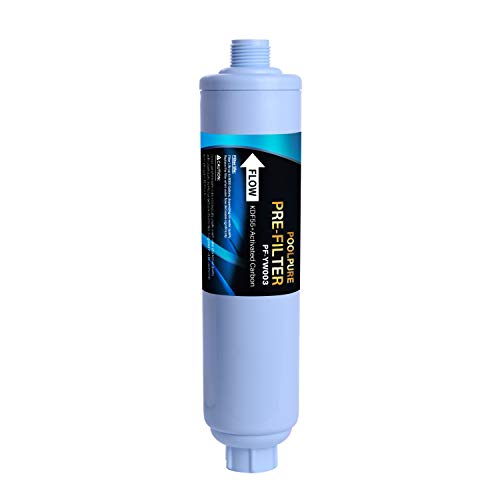
A hose pre-filter (a cylinder attachment that screws onto the end of your standard garden hose) catches physical sediment, rust, iron, and heavy minerals before they enter your pool. Passing hose water through activated carbon or sediment media prevents stubborn brown rust stains on your new vinyl floor and stops scaling along the pool walls. When choosing a hose pre-filter, check that it features standard 3/4-inch garden hose threads and carries a filtration capacity rated for at least 8,000 to 10,000 gallons so it lasts through the entire fill.
An automatic pool fill shutoff valve protects your yard from catastrophic flooding if you need to leave the house or sleep while the pool fills. These devices clamp securely onto the pool rail or wall and use a mechanical float arm, similar to the float inside a toilet tank. As the pool water reaches your desired waterline, the rising float naturally closes the internal valve and cuts off the water supply completely.
When selecting an auto-fill shutoff valve, verify that the bracket fits your pool wall style, whether you have an above-ground metal frame or an in-ground coping ledge. Look for sturdy weighted or non-slip rubber bases that will not tip into the pool, along with an adjustable float arm that lets you set the shutoff point exactly at the halfway mark of your skimmer.

- VC Score9.4
BCP Score is a ranking system developed by bestcleanerproducts.com. BCP Score has no relationship or impact from any manufacturers or sales agent websites. Learn more
- BrandFill-O-Matic

- VC Score9.2
BCP Score is a ranking system developed by bestcleanerproducts.com. BCP Score has no relationship or impact from any manufacturers or sales agent websites. Learn more
- BrandIntex

- VC Score9.0
BCP Score is a ranking system developed by bestcleanerproducts.com. BCP Score has no relationship or impact from any manufacturers or sales agent websites. Learn more
- BrandIntex

- VC Score8.8
BCP Score is a ranking system developed by bestcleanerproducts.com. BCP Score has no relationship or impact from any manufacturers or sales agent websites. Learn more
- BrandGuardian Filtration Products

- VC Score8.8
BCP Score is a ranking system developed by bestcleanerproducts.com. BCP Score has no relationship or impact from any manufacturers or sales agent websites. Learn more
- BrandIntex
- VC Score8.6
BCP Score is a ranking system developed by bestcleanerproducts.com. BCP Score has no relationship or impact from any manufacturers or sales agent websites. Learn more
- BrandPOOLPURE

- VC Score8.6
BCP Score is a ranking system developed by bestcleanerproducts.com. BCP Score has no relationship or impact from any manufacturers or sales agent websites. Learn more
- BrandBylot

- VC Score8.4
BCP Score is a ranking system developed by bestcleanerproducts.com. BCP Score has no relationship or impact from any manufacturers or sales agent websites. Learn more
- BrandPOOLPURE

- VC Score8.2
BCP Score is a ranking system developed by bestcleanerproducts.com. BCP Score has no relationship or impact from any manufacturers or sales agent websites. Learn more
- BrandPoolzilla

- VC Score8.2
BCP Score is a ranking system developed by bestcleanerproducts.com. BCP Score has no relationship or impact from any manufacturers or sales agent websites. Learn more
- BrandVivlly

- VC Score6.8
BCP Score is a ranking system developed by bestcleanerproducts.com. BCP Score has no relationship or impact from any manufacturers or sales agent websites. Learn more
- BrandHydro Life
Last update on 2026-10-08 / Affiliate links / Images, Product Titles, and Product Highlights from Amazon Product Advertising API


How to Refinish a Fiberglass Pool

How Do You Keep Raccoons Out of Your Pool?

How to Fix Cyanuric Acid in Your Pool

How to Shape a Pool Cue Tip to Stop Miscues

12 Best Automatic Vacuum For Intex Above Ground Pool of 2026 To Keep Vinyl Floors Spotless

10 Best Automatic Pool Vacuum For Above Ground Pool of 2026 To End Manual Scrubbing

How Much Pool Clarifier Should You Use for Your Pool Size?

How Much Does a Pebble Tec Pool Cost to Build or Resurface?


