
How Much Does It Cost to Fill a Pool?

Running a garden hose to fill a backyard swimming pool is surprisingly affordable for most households, while bringing in a commercial water truck represents a much larger expense. That bottom line changes primarily based on how many gallons the basin holds and where that water originates.
City water rates differ dramatically between regions, and sewer treatment charges can quietly double a municipal bill unless the local utility waives them for outdoor fills. Drawing from a private well avoids city water charges completely, but running an outdoor spigot continuously for days risks overheating the pump motor or stirring up ground sediment. Calculating the pool dimensions and checking how local utilities charge for high volume will keep the entire process simple and predictable.
Typical Fill Costs Across Different Water Sources
The total price to fill a swimming pool changes drastically depending on where your water comes from. Most homeowners choose between municipal city tap water, a private residential well, or a commercial bulk water delivery service. Each option comes with its own balance of upfront fees, equipment risks, and setup time.
City tap water is almost always the most affordable choice for residential areas. Municipal suppliers charge for water by volume, typically measured in units of 1,000 gallons or hundred cubic feet (CCF). Across most American towns, the base water supply rate ranges between $4 and $10 per 1,000 gallons. For an average 15,000-gallon pool, the raw water itself costs roughly $60 to $150. If your utility automatically tags on wastewater fees, that total can rise to $150 to $300 unless you request an adjustment.
Private well water feels free on the surface because you do not receive a monthly water utility bill. The true cost comes down to electrical power and pump wear. Drawing 15,000 to 20,000 gallons of water through your pressure tank requires your well pump to run for dozens of hours, which costs roughly $5 to $20 in household electricity. But the hidden danger is well pump burnout, which is motor overheating from running dry. If your water table drops faster than the well can refill, the pump pulls air, overheats, and burns out. Replacing a deep well pump commonly costs $1,500 to $3,500, turning a cheap fill into an expensive plumbing emergency.
Bulk water delivery trucks provide an alternative when tap water is unavailable or local wells run shallow. Professional water hauling services bring clean water directly to your driveway in tanker trucks carrying 5,000 to 9,000 gallons per load. A single truckload generally costs $250 to $600 depending on your distance from the filling terminal. Filling an entire 20,000-gallon in-ground concrete pool requires two to three truckloads, bringing the total expense to somewhere between $750 and $1,800. While truck delivery costs significantly more than tap water, it fills the pool in two hours and eliminates any strain on your home plumbing.
Your pool structure also influences this calculation. Compact backyard designs, like those seen when looking at the cost to install a cocktail pool, hold around 4,000 to 7,000 gallons and can be filled from a single hose in one afternoon for under $50. In contrast, large custom installations holding 30,000 gallons require careful scheduling to avoid utility surcharges or days of continuous pumping.
How to Calculate Your Pool Volume in Five Steps
Before you turn on the spigot or call a water hauler, you need to know exactly how much water your pool holds. Guessing can lead to unexpected utility bracket jumps or ordering too many tanker deliveries. Follow these five steps to find your exact pool volume in gallons.
- Measure the pool length and width in feet.
Reason: These baseline dimensions give you the total surface footprint of your pool. For round pools, measure straight across the widest point through the middle to find the diameter.
- Calculate your average water depth in feet.
Reason: Most pools feature a shallow end and a deep end, so using the maximum depth skews your calculations too high. Measure the depth at the shallowest point and the deepest point, add those two measurements together, and divide by two. Measure only to the waterline (the tile border where water meets the pool wall) rather than the pool coping edge, similar to how you measure when determining how deep the water is in a 48-inch pool.
- Determine your surface square footage based on pool shape.
Reason: Different pool shapes require different geometry formulas to find the interior volume accurately. For standard rectangles, multiply length by width. For round pools, multiply the radius (half the diameter) by itself, then multiply by 3.14. For kidney or freeform pools, multiply the longest length by the average width, then multiply that result by 0.85 to account for the curved corners.
- Multiply the surface square footage by the average depth, then multiply by 7.5.
Reason: Multiplying surface area by average depth gives you the volume in cubic feet. Because each cubic foot of space holds roughly 7.48 gallons of liquid, multiplying your total cubic feet by 7.5 converts your physical measurements into liquid gallons.
- Check your local water bill to find your utility billing unit.
Reason: Water providers do not all bill using the same formula. Some bill per 1,000 gallons, while others bill in hundred cubic feet (CCF), where 1 CCF equals 748 gallons. Dividing your total pool gallons by your utility's billing unit allows you to calculate the precise dollar amount before opening your outdoor faucet.
How to Check Your Utility Bill and Request a Sewer Credit
The single biggest financial shock on a pool fill bill rarely comes from the water itself. It comes from the sewer fee, which is the waste treatment charge on your water bill. In most municipal districts, the city assumes that every single gallon of water passing through your household meter eventually goes down a sink, tub, or toilet drain to reach the public treatment plant. Because wastewater processing is energy intensive, sewer charges often cost one to two times more than the actual drinking water rate.
When you fill a swimming pool, that water stays in your backyard and never enters the municipal sewer pipes. Paying sewer fees on 20,000 gallons means paying for a waste treatment process that never occurred. Fortunately, many water departments offer a sewer credit, pool fill adjustment, or auxiliary meter program if you contact them in advance.
Call your municipal water office before turning on your garden hose. Ask customer service if they offer a pool fill waiver or credit program. Some cities require you to submit water meter numbers immediately before you start filling and right after you shut off the water. Other municipalities will look at your historical water usage from the previous year and cap your sewer bill at your normal monthly baseline, waiving the rest of the volume charge. In some areas, the city will even rent you an auxiliary meter that connects directly to your outdoor hose bib so that pool water bypasses the sewer billing calculation entirely.
Be aware of tiered pricing schedules as well. Many utilities use graduated brackets where the first 5,000 gallons cost a standard baseline rate, but usage beyond 15,000 or 20,000 gallons in a single monthly billing cycle jumps into a higher conservation tier. If your city does not offer a sewer credit or flat-rate pool adjustment, you can sometimes save money by spreading your fill across two consecutive billing cycles, running the hose for half the pool at the end of one cycle and finishing at the start of the next.
Garden Hose Versus Delivery Truck: Which Should You Choose?
Deciding between a garden hose and a bulk water delivery truck comes down to three factors: fill speed, pool interior surface protection, and source water chemistry.
Speed is the most obvious difference. A standard residential garden hose running at normal municipal pressure delivers roughly 5 to 10 gallons per minute, which is known as its flow rate. At a steady flow rate of 8 gallons per minute, filling a 16,000-gallon pool takes around 33 hours of continuous operation. In contrast, a commercial delivery tanker unloads between 5,000 and 9,000 gallons in 20 to 45 minutes using heavy-duty discharge pumps. If you need your pool ready immediately for an event or need to get the filter running without delay, truck delivery wins on convenience.
Your pool interior material also plays a huge role in which method is safest. If you have a freshly plastered concrete or gunite pool, continuous filling is mandatory. Plaster cures under water, and if the water stream stops for several hours under direct sunlight, a permanent ring can bake into the finish at the stopping line. If your municipal supply has low water pressure or your well cannot sustain 30 hours of continuous pumping, ordering water trucks guarantees a swift, seamless fill that protects fresh plaster. Vinyl liner pools also benefit from rapid water weight, as the initial 12 inches of water must pin the liner against the floor and slope before wrinkles can form.
Water quality is the final consideration. Municipal tap water is already treated and sanitized, making chemical balancing relatively easy once the pool is full. Well water, however, frequently contains dissolved iron, copper, and calcium. When you shock a pool filled with raw well water, the chlorine oxidizes those dissolved minerals instantly, turning the pool brown or emerald green and creating tough stains on fiberglass or pebble aggregate surfaces. Commercial pool water delivery trucks typically bring municipal drinking water or pre-filtered pool water that contains zero dissolved metals, saving you hundreds of dollars in stain removers and metal sequestrants down the road.
Best Practices During Fill-Up to Protect Your Pool and Plumbing
Filling a pool requires monitoring to avoid property damage, equipment failure, and structural issues. Use this practical checklist while your water is running:
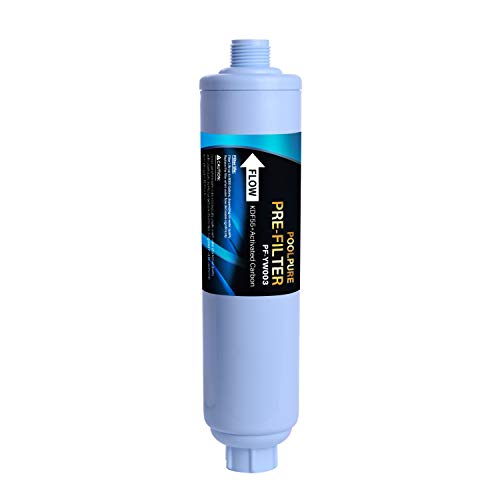
- Attach a hose pre-filter to your outdoor spigot. A pre-filter is a hose attachment that traps metals and sediment before they reach your pool water. Screwing this canister onto your garden hose captures rust, silt, and heavy metals right at the faucet, preventing discoloration on smooth fiberglass or vinyl liners.
- Use a mechanical hose timer. Leaving a hose running overnight or while you run errands can easily cause an overflow. An accidental overflow wastes thousands of gallons, inflates your utility bill, and can wash away backfill soil around pool walls or float a fiberglass shell out of the ground. Set a mechanical timer to shut the spigot off automatically every 4 to 6 hours.
- Wrap the metal hose nozzle in a soft towel. Never let bare brass or aluminum hose fittings vibrate against the floor of an empty pool. The vibration can chip soft marcite plaster, mark pebble finishes, or puncture a vinyl liner floor. Wrap the hose end in a microfiber cloth or clean tube sock, and weigh it down gently with a soft sandbag.
- Give your private well regular rest cycles. If you must fill from a residential well, never run the hose around the clock. Run the water for two hours, then shut it down for two hours to allow the underground aquifer and pressure tank to recover. This cycling keeps the pump motor cool and prevents well pump burnout.
- Keep the main pool pump switched off until the skimmer is half full. Never start your circulation system while the water level sits below the middle of the skimmer mouth. Understanding how a pool pump works makes the reason clear: running a pump without water draws air into the lines, which quickly burns out the internal shaft seal and melts the pump housing.
What to Look for in Pool Cleaning Equipment for Fresh Water
Once your pool reaches the proper operating level on the tile line, the water will look clean, but it will quickly collect dust, dirt, and microscopic settling particles. If your pool was recently resurfaced or built, plaster dust will constantly settle across the floor during the first two weeks. Having the right cleaning equipment on hand keeps this initial debris from overloading your main filtration tank.
When selecting a dedicated pool cleaner for a freshly filled pool, prioritize models with internal collection canisters that capture fine silt and plaster dust before it reaches the skimmer. For smooth vinyl or fiberglass shells, choose cleaners equipped with soft rubber drive wheels or foam rollers that provide gentle traction without scratching. For rough concrete or pebble aggregate pools, look for durable rubber tracks and sturdy bristles capable of sweeping heavy settling dirt off the floor. Skimmer basket socks made of ultra-fine mesh are also an inexpensive, essential tool to slip over your skimmer baskets during the initial week of circulation to protect your filter media from fine construction dust.

- VC Score9.2
BCP Score is a ranking system developed by bestcleanerproducts.com. BCP Score has no relationship or impact from any manufacturers or sales agent websites. Learn more
- BrandMadayFormula

- VC Score9.0
BCP Score is a ranking system developed by bestcleanerproducts.com. BCP Score has no relationship or impact from any manufacturers or sales agent websites. Learn more
- BrandAMERICAN LUXURY GIFTS

- VC Score9.0
BCP Score is a ranking system developed by bestcleanerproducts.com. BCP Score has no relationship or impact from any manufacturers or sales agent websites. Learn more
- BrandIntex

- VC Score8.8
BCP Score is a ranking system developed by bestcleanerproducts.com. BCP Score has no relationship or impact from any manufacturers or sales agent websites. Learn more
- BrandAMERICAN LUXURY GIFTS

- VC Score8.8
BCP Score is a ranking system developed by bestcleanerproducts.com. BCP Score has no relationship or impact from any manufacturers or sales agent websites. Learn more
- BrandMerkia

- VC Score8.8
BCP Score is a ranking system developed by bestcleanerproducts.com. BCP Score has no relationship or impact from any manufacturers or sales agent websites. Learn more
- BrandGuardian Filtration Products

- VC Score8.8
BCP Score is a ranking system developed by bestcleanerproducts.com. BCP Score has no relationship or impact from any manufacturers or sales agent websites. Learn more
- BrandWWD POOL
- VC Score8.6
BCP Score is a ranking system developed by bestcleanerproducts.com. BCP Score has no relationship or impact from any manufacturers or sales agent websites. Learn more
- BrandPOOLPURE
- VC Score8.6
BCP Score is a ranking system developed by bestcleanerproducts.com. BCP Score has no relationship or impact from any manufacturers or sales agent websites. Learn more
- BrandJasonwell

- VC Score8.6
BCP Score is a ranking system developed by bestcleanerproducts.com. BCP Score has no relationship or impact from any manufacturers or sales agent websites. Learn more
- BrandVIVI MAO

- VC Score8.2
BCP Score is a ranking system developed by bestcleanerproducts.com. BCP Score has no relationship or impact from any manufacturers or sales agent websites. Learn more
- BrandInsoma
Last update on 2026-10-08 / Affiliate links / Images, Product Titles, and Product Highlights from Amazon Product Advertising API
Frequently Asked Questions
Can I use a local fire hydrant to fill my pool?
You cannot simply open a neighborhood hydrant yourself, as tampering with public hydrants is illegal and carries severe fines. However, some municipal fire departments or public works offices allow residents to rent a temporary hydrant meter and backflow preventer for a modest permit fee. If this service is offered in your town, it can fill an entire pool in a couple of hours using city-metered water.
Will running a garden hose continuously burn out a private well pump?
Running a garden hose continuously can overheat and damage a private well pump if the flow rate of the hose exceeds the recharge rate of the underground well. When the water level in the well drops below the pump intake, the pump pulls air and loses cooling water, causing the motor to burn out. To protect your well, cycle the water in two-hour shifts and monitor your home faucets for air sputtering.
How long does it take to fill an average swimming pool with a garden hose?
An average 15,000 to 20,000-gallon swimming pool takes between 24 and 48 hours to fill when using a single standard garden hose. Using two hoses connected to separate outdoor spigots can cut that time nearly in half, provided your household water pressure and supply line can deliver the extra volume. You can check your spigot flow rate by timing how many seconds it takes to fill a five-gallon bucket.
Should I balance the water chemistry immediately after filling?
You should begin balancing your water chemistry as soon as the water reaches the midpoint of the skimmer and the circulation pump is running. Fresh tap and truck water lack sanitizer, calcium, and stabilizer, leaving the water vulnerable to rapid algae blooms within 24 to 48 hours of sun exposure. Sample the water immediately to check pH, total alkalinity, and calcium hardness before adding chlorine.


How to Refinish a Fiberglass Pool

How Do You Keep Raccoons Out of Your Pool?

How to Fix Cyanuric Acid in Your Pool

How to Shape a Pool Cue Tip to Stop Miscues

12 Best Automatic Vacuum For Intex Above Ground Pool of 2026 To Keep Vinyl Floors Spotless

10 Best Automatic Pool Vacuum For Above Ground Pool of 2026 To End Manual Scrubbing

How Much Pool Clarifier Should You Use for Your Pool Size?

How Much Does a Pebble Tec Pool Cost to Build or Resurface?


