
Relying on standard manifold gauges to verify an AC pull-down is the fastest way to ruin a brand-new compressor. Analog dials bottom out around 29 or 30 inches of mercury, leaving thousands of hidden microns of moisture trapped inside copper tubing. Once refrigerant mixes with that lingering moisture, it creates corrosive acid that quietly eats motor windings and expansion valves from the inside out. Flimsy gauge fittings only multiply the headache, leaking ambient air past loose threads and triggering phantom decay readings that burn hours chasing micro-leaks that do not exist.
Walking away from an evacuation with total peace of mind means knowing the system is genuinely dry and holding vacuum before cracking service valves. Achieving that clean finish comes down to a solid brass 1/4-inch SAE port connection that holds an airtight seal, backed by precise micron resolution that reacts instantly to true pressure changes. Wireless notifications and decay hold alarms make the process even smoother, sparing you from babysitting the lines while the gauge measures stability. Below, explore the standout vacuum gauges built to verify a leak-tight evacuation on every job this 2026.


Dedicated leak check mode pairs with an integrated alarm and temperature compensation to flag pressure rises during system holds.
Key specs
- Supported Pressure Units
- Torr, mbar, inHg, hPa
Pros:
- Direct 1/4 inch SAE interface fits standard HVAC service ports without extra adapters
- High stated precision with 0.01 resolution and plus or minus 0.2 percent accuracy
- Includes dedicated leak check mode and built-in alarm alerts for evacuation holds
- Large 3-inch backlit LCD screen provides clear visibility in low-light utility rooms
Cons:
- Units listed are Torr, mbar, inHg, and hPa, so direct micron readout is not specified
- Lacks wireless connectivity for remote decay tracking from a mobile app

Built-in alarm alerts sound once the target vacuum level is reached, preventing the need to continuously watch the screen.
Key specs
- Micron Range
- 0 to 300,000 microns
Pros:
- Broad measurement range spanning from 0 to 300,000 microns for full evacuation tracking
- Direct 1/4 inch SAE connection mounts straight to standard refrigerant service ports
- Audible alarm alerts notify you when reaching the targeted vacuum threshold
- Backlit digital display allows easy reading in unlit mechanical spaces
Cons:
- Does not include wireless or app logging for hands-off decay monitoring
- Operating accuracy percentage is not detailed in the product specifications

WIDE MEASUREMENT RANGE & HIGH ACCURACY: Used to test system leak and discern vacuum pump quality of the evacuation in an HVAC and refrigeration system; accurate measurements from 760000 Microns (atmosphere) to 0 Micron. Accuracy: ±10% or ±10 MicronMULTIFUNCTIONAL DESIGN: Settable target, notificatio
Key specs
- Full Scale Range
- 0 to 760,000 microns
- Data Logging Capability
- Offline recording saves vacuum hold data directly to the unit, while mobile app alerts notify you of pressure rises from afar.
Pros:
- Full-range scale from atmospheric pressure down to zero across 0 to 760,000 microns
- Wireless app connectivity lets you track decay holds remotely on your smartphone
- Offline data recording logs evacuation progress even if the mobile device disconnects
- Supplied adapter and 1/4 inch SAE fitting ensure flexible line hookups
Cons:
- Bulkier housing profile compared to compact direct-probe vacuum sensors
- Requires mobile app navigation to configure advanced logging and alarm functions

An adjustable threshold alert allows technicians to configure specific micron targets suited for standard AC or heat pump evacuations.
Key specs
- Included Fittings
- 1/4 inch SAE connector
- Dedicated T-connector for in-line plumbing
Pros:
- Reads deep vacuum across a 0 to 75,000 micron span for precise heat pump evacuation
- Includes a T-connector alongside the 1/4 inch SAE fitting for flexible manifold setups
- Adjustable alarm lets technicians tailor custom vacuum threshold limits
- Auto shut-off function helps preserve battery life during long service jobs
Cons:
- Lacks wireless app integration for remote decay observation
- Measurement accuracy percentage is not stated in the manufacturer listing

UPGRADED ELITECH TOOLS APP(ioS and Android): An intergraded app, that allows users to manage all Elitech tools such as vacuum pump, digital manifold, vacuum gauge, pressure gauge, refrigerant charging scale on one app, more efficient and more intelligent.MULTIFUNCTIONAL DESIGN: Settable target, noti
Key specs
- Rechargeable Power
- Internal rechargeable battery
- Deep Evacuation Span
- 0 to 19,000 microns
Pros:
- Internal rechargeable battery eliminates the recurring need for disposable dry cells
- Wireless app integration provides live decay graphs and remote threshold alarms
- Offline recording tracks hold curves even if the phone loses local connection
- Includes temperature compensation and standard 1/4 inch SAE connection with adapter
Cons:
- Capped at 19,000 microns, so it cannot track initial rough evacuation from atmosphere
- Requires recharging downtime if the battery depletes in the middle of a service call
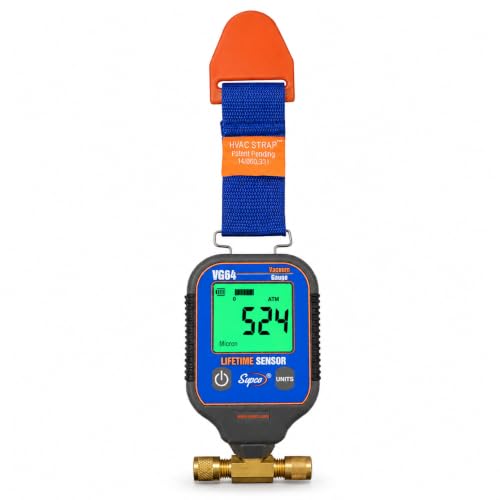
Key specs
- Connection Type
- 1/4 inch male flare fitting
- Rated Precision
- 10 percent accuracy
Pros:
- Dedicated deep vacuum focus from 0 to 12,000 microns tailored for HVAC dehydration
- Direct 1/4 inch male flare connection screws firmly onto service ports and hoses
- Compact housing profile fits into tight spaces around outdoor condensing units
Cons:
- Stated accuracy of 10 percent is broader than modern digital alternatives
- Does not offer wireless app logging, backlit screen, or multiple unit conversions

Tracks both temperature and ambient humidity alongside vacuum depth, helping verify ambient conditions during line dehydration.
Key specs
- Sensor Architecture
- Pirani thermal sensor
Pros:
- Integrated Pirani sensor delivers sensitive response across 0 to 75,000 microns
- Full-color TFT display provides clear graphical readout of vacuum status
- Built-in temperature and ambient humidity measurement for thorough environmental tracking
- Supports 9 switchable pressure units via standard 1/4 inch SAE connection
Cons:
- Does not offer wireless Bluetooth or smartphone application connectivity
- Sensor must be shielded from direct compressor oil exposure to maintain accuracy

Combines auto-calibration routines with smart leak detection to verify steady pressures during vacuum hold checks.
Key specs
- Port Specification
- 7/16-20 UNF (1/4 inch SAE)
Pros:
- High accuracy rating of plus or minus 0.2 percent full scale with auto calibration
- Built-in smart evacuation and leak detection modes simplify hold evaluations
- Standard 7/16-20 UNF (1/4 inch SAE) fitting mounts directly to service valves
- Spacious 3-inch LCD screen delivers readable metrics at a glance
Cons:
- Lists units in Torr, mbar, hPa, and inHg without explicit micron display confirmation
- Lacks Bluetooth or app support for remote wireless vacuum monitoring

Key specs
- Pressure Scale Range
- 0 to 75,000 microns
- Plumbing Hardware
- 7/16-20 UNF main port
- 1/4 inch SAE adapter fitting
- In-line T-connector
Pros:
- Deep vacuum measurement range spanning from 0 to 75,000 microns
- Offers 11 switchable pressure units for versatile HVAC and lab configurations
- Packaged with both a 1/4 inch SAE fitting and a T-connector for manifold tie-in
- Standard 7/16-20 UNF threaded interface ensures a tight mechanical seal
Cons:
- No wireless connectivity for smartphone monitoring or digital data export
- Display backlight and screen specifications are not detailed in the product data

A 45-degree angled port connector allows direct mounting to tight access valves without straining access fittings or hoses.
Key specs
- Protection Rating
- IP54 water and dust protection
Pros:
- Angled 45-degree service-port design attaches easily in cramped condenser housings
- IP54 rated splash and dust protection withstands outdoor weather and service conditions
- Wireless Bluetooth connection pairs directly with mobile app for graphic decay holds
- Compact standalone probe design connects straight to line valves without bulky hoses
Cons:
- Has no built-in screen, requiring a paired smartphone or manifold to view readings
- Full micron numerical range is not detailed in the product specifications

Automatic calibration and temperature compensation work together to keep pressure measurements stable during leak checks.
Key specs
- Display Interface
- 3-inch backlit LCD
Pros:
- High accuracy rating of plus or minus 0.2 percent with automatic calibration
- Integrated temperature compensation helps stabilize readings against thermal drift
- Dedicated evacuation and leak decay modes assist with systematic hold verification
- Generous 3-inch backlit LCD screen ensures readability in dim utility areas
Cons:
- Supports 4 pressure units but does not state native micron display support
- Lacks wireless data transmission or remote alarm capabilities
Last update on 2026-10-31 / Affiliate links / Images, Product Titles, and Product Highlights from Amazon Product Advertising API
Does a digital vacuum gauge read deep vacuum in microns?
Yes, digital vacuum gauges measure deep evacuation levels down into fine micron increments that analog manifold dials cannot display. Listed measurement spans vary across models, such as 0 to 12000 microns on the Supco VG64, 0 to 19000 microns on the Elitech VGW-Mini, 0 to 75000 microns on units like the PYY, VANLISON, and ROGVOC, 0 to 300,000 microns on the Hilmor CVG1200, and up to 0 to 760000 microns on the Elitech VGW-760Pro. These broad micron ranges allow you to confirm moisture removal and track pull-down progress from atmospheric pressure down to deep target levels.
Will a digital vacuum gauge connect directly to a standard 1/4 inch SAE service port?
Yes, HVAC digital vacuum gauges connect to standard 1/4 inch SAE access ports or equivalent 7/16-20 UNF fittings. Gauges such as the Hilmor CVG1200, Elitech VGW-760Pro, and Supco VG64 feature 1/4 inch SAE or male flare interfaces directly on the body. Other options like the ROGVOC, EVSTUL, and Digital Vacuum Gauge Pro specify 7/16-20 UNF threading with included 1/4 inch SAE brass fittings or T-connectors, allowing you to secure a tight seal directly onto access valves or core depressors without risking seal degradation.
How can you verify vacuum decay without standing right beside the manifold?
You can monitor decay holds remotely by choosing a micron gauge equipped with wireless mobile app connectivity or audible target alerts. Wireless models like the Elitech VGW-760Pro and VGW-Mini provide app alarms and offline data recording to log micron drift. If you prefer self-contained hardware, the Hilmor CVG1200 and PYY include built-in audible alarm alerts, while the EVSTUL and Digital Vacuum Gauge Pro provide dedicated evacuation and leak check modes with auto calibration shown on a 3-inch backlit LCD.
What pressure units can digital vacuum gauges display during evacuation?
Many digital vacuum gauges switch across multiple international units to match specific system requirements. The EVSTUL and PYY provide 4 selectable units, while units like the Digital Vacuum Gauge Pro display Torr, mbar, inHg, and hPa with ±0.2% full-scale accuracy and 0.01 resolution. Advanced displays provide wider selections, including the VANLISON with 9 units alongside temperature and humidity measurements, and the ROGVOC with 11 switchable units. Check the display configuration on your unit before starting work to confirm it supports your preferred scale.
What should you do if oil enters the vacuum gauge sensor?
Rinse the port cavity immediately with pure isopropyl alcohol to remove residue before it causes drifting numbers or inaccurate decay measurements. Contamination directly impacts sensitive components such as the Pirani sensor on the VANLISON gauge, leading to false micro-leak indications. Place several drops of alcohol inside the 1/4 inch port, shake it gently, empty it out, and allow the sensor to dry completely. For general maintenance around job sites and service vehicles, knowing how to open a vacuum filter helps maintain clean surroundings, but an HVAC vacuum sensor housing must never be disassembled or probed with physical tools.
Why are auto calibration and backlit screens useful on evacuation gauges?
Auto calibration maintains reading precision across temperature shifts, while backlit screens ensure clear visibility in dark mechanical rooms or cramped crawlspaces. Instruments like the EVSTUL and Digital Vacuum Gauge Pro incorporate auto calibration with 3-inch backlit LCD screens to deliver clear ±0.2% accuracy readings during deep evacuation. Keeping your equipment clean on dusty jobs is essential, much like understanding how to open the bottom of a vacuum when servicing portable shop gear. Always confirm screen readability and zero-point calibration options to prevent misleading decay measurements on outdoor service calls.




