A simple glass bulb looks completely adequate on a spec sheet, but an unexpected pressure surge during distillation can instantly turn an under-sized reservoir into an open pathway for volatile fumes. When aggressive acid mist or biological fluids slip past an improper barrier, pump oil turns cloudy within hours, internal seals harden, and a costly mechanical rebuild brings the entire bench to a standstill. Even a slight mismatch between a 10mm hose barb and standard tubing or an ungreased ground joint can leak atmospheric air continuously, ruining baseline vacuum depth while leaving gummy residues baked into narrow glass chambers.
Work moves much faster when every condensation bath catches runaway vapors before they ever reach mechanical parts. Solving this comes down to matching vessel geometry and materials to the specific task at hand. Heavy-wall borosilicate traps submerged in dry ice slush reliably knock down volatile organic solvents, whereas dual-bottle plastic systems with hydrophobic vent filters physically lock away biohazard aspirates. Opting for separable bodies simplifies daily residue cleanup, while confirming connection standards like 24/40 joints secures an airtight seal from the very first pull. Here is how the most dependable lab vacuum traps stack up for shielding your hardware and keeping pressure rock steady.


Key specs
- Ground Joint Standard
- 24/29 standard taper
- Condensation Length
- 250 mm
Pros:
- Borosilicate glass construction provides high resistance to chemical corrosion and thermal shock
- Features a 24/29 ground glass joint for direct attachment to European-standard glassware setups
- 250mm overall length provides ample condensation surface area inside cold bath dewars
- Bubbler design directs vapor flow downward to maximize contact with refrigerated zones
Cons:
- European 24/29 joint requires adapters if connecting to standard US 24/40 laboratory lines
- Listing does not specify the outer hose barb diameter, requiring tube sizing verification

Designed with standard 24/40 ground glass joints to integrate directly into domestic vacuum manifolds.
Key specs
- Ground Joint Size
- 24/40 standard taper
Pros:
- Standard 24/40 ground joint mates directly with common North American laboratory glassware
- Dedicated glass cold trap layout separates condensable vapors ahead of the vacuum pump
- Sturdy laboratory-grade glass build withstands chemical exposure during routine evaporation
Cons:
- Listing omits hose barb measurements, so port dimensions must be checked before ordering
- Overall body dimensions and vessel capacity are unstated in the manufacturer specs

Key specs
- Hose Barb Diameter
- 10 mm serrated
- Sub-Joint Immersion Depth
- 200 mm
Pros:
- 10mm serrated hose connection grips flexible vacuum tubing securely to resist slipping under vacuum
- Standard 24/40 ground joint provides an airtight fit with mainstream distillation assemblies
- 200mm length below the joint allows deep submersion into dry ice or liquid nitrogen dewars
- Bubbler flow path guides vapors along chilled walls to protect pump oil from solvent mist
Cons:
- 10mm barb requires matching metric tubing or step-down adapters for 1/4-inch or 3/8-inch lines
- Narrow lower glass body requires deliberate solvent flushing when clearing viscous residues

Key specs
- Body Construction
- One-piece seamless borosilicate
- Chamber Outer Diameter
- 30 mm
Pros:
- One-piece borosilicate glass construction eliminates joint seams that could develop vacuum leaks
- Compact 30mm outer diameter fits easily into narrow dewar flasks or restricted benchtop spaces
- Spherical condensation chamber creates targeted surface contact for volatile solvent capture
- 200mm length provides balanced vapor residence time without excessive vertical clearance needs
Cons:
- Compact 30mm outer diameter limits solvent holding capacity during high-volume evaporation
- Specific hose connection dimensions are not detailed, requiring tubing confirmation

Equipped with 1/4-inch ID tubing connections and an inline vent filter to stop aerosol migration.
Key specs
- Fluid Storage Volume
- 4L primary + 4L overflow
Pros:
- Dual 4L polypropylene bottles provide high fluid volume retention for biological aspiration workflows
- Secondary 4L overflow bottle acts as a failsafe barrier to prevent liquids from reaching the pump
- Entire polypropylene assembly is fully autoclavable for sterile culture decontamination
- Includes an inline vent filter to trap biological aerosols before air exhausts to the vacuum line
- Configured with 1/4-inch inner diameter tubing fittings for standard lab aspiration setups
Cons:
- Polypropylene construction is not suitable for aggressive organic solvent condensing
- Dual 4L footprint requires considerable benchtop or under-hood operating space

Key specs
- Condensate Volume
- 500 ml
- Tubing Accessory
- Latex tube included
Pros:
- Generous 500ml holding capacity captures significant condensate before requiring draining
- Built from durable borosilicate glass to handle corrosive chemical vapors and thermal shifts
- Includes flexible latex tubing out of the box to expedite initial line setup
- 24/29 ground glass joint fits seamlessly into European-pattern laboratory glassware systems
Cons:
- Requires an adapter to connect with North American standard 24/40 joint glassware
- Latex tubing deteriorates when exposed to certain organic solvent vapors, requiring chemical checks

Key specs
- Chamber Outer Diameter
- 55 mm
- Vapor Condensation Span
- 350 mm
Pros:
- Seamless one-piece borosilicate body eliminates ground joint seals that risk vacuum leakage
- Broad 55mm outer diameter delivers a large surface area for condensing volatile solvent fumes
- Extended 350mm length ensures deep immersion in cooling baths for high thermal transfer efficiency
- Heavy-duty glass wall construction resists cracking under full laboratory vacuum draw
Cons:
- 350mm vertical length demands taller dewar flasks and ample vertical hood clearance
- Hose barb diameter is not specified in product documentation, needing manual measurement

Features an integrated glass jacket that circulates chiller fluid directly around the internal vapor path.
Key specs
- Wall Construction
- Double-wall jacketed
Pros:
- Double-wall jacketed design circulates coolant directly around the trap without external dewar baths
- Borosilicate glass structure provides inert resistance against acid, base, and solvent vapors
- Self-contained cooling jacket minimizes benchtop clutter around the primary vacuum manifold
Cons:
- Unstated joint dimensions and barb sizes require verification against your tubing setup
- Overall length and internal volume specifications are omitted from the listing data

Key specs
- Vessel Volume
- 10 ml
- Tube Configuration
- Dual bend tube joint
Pros:
- Compact 10ml volume fits tight microscale reaction systems and compact distillation trains
- Dual bend tube joint routes gas through the liquid or chilled zone to scrub incoming vapors
- Glass construction allows immediate visual inspection of trapped liquid droplets or color changes
Cons:
- Tiny 10ml capacity quickly overflows in standard-scale chemical evaporation workflows
- Ground joint size and tubing barb dimensions are not specified in the listing specs

Key specs
- Hose Barb Diameter
- 10 mm hose barb
- Cooling Tube Length
- 200 mm
Pros:
- 10mm hose barb connections pair directly with thick-walled laboratory vacuum tubing
- 200mm cooling tube geometry promotes efficient solvent recovery during routine distillation
- Chemical-resistant borosilicate glass prevents degradation when exposed to organic solvent fumes
- Bubbler design directs incoming vapor stream deep into the cold zone for reliable recovery
Cons:
- Fixed one-piece body requires solvent rinsing through hose barbs to clear stubborn residues
- Ground joint size is omitted from the listing data, so check manifold connection styles

Uses a 53mm VersaCap with dual 1/4-inch hose barbs and an integrated sealable vent port.
Key specs
- Aspiration Vessel Sizing
- 2L primary + 1L secondary
Pros:
- Heavy-duty HDPE dual bottle system (2L primary plus 1L secondary) safeguards pumps from liquid carryover
- Bleach-compatible construction enables safe decontamination of aspirated cell culture biohazards
- 53mm VersaCap features two 1/4-inch hose barbs and a sealable vent port for secure hose attachment
- Includes a secondary containment basin to contain accidental benchtop spills during handling
Cons:
- HDPE bottles are unsuitable for condensing volatile organic solvents or high-heat distillations
- Incompatible with dry ice or liquid nitrogen cold bath setups designed for glass cold traps

Key specs
- Barbed Hose Interface
- 10 mm serrated
- Sub-Joint Immersion Depth
- 200 mm below 24/40 joint
Pros:
- Standard 24/40 ground glass joint attaches directly to common US lab glassware configurations
- 10mm serrated hose connection holds firm under vacuum draw to prevent air leak ingress
- 200mm length below the joint provides optimal immersion depth for standard dewar flasks
- Durable borosilicate glass withstands thermal cycling and aggressive chemical solvent vapors
Cons:
- Serrated barb is sized for metric 10mm ID hoses, requiring adapters for 1/4-inch vacuum lines
- Single joint style requires adequate clamping support to avoid strain on the glassware neck

Combines a 24/40 ground joint with dual 10mm hose barbs for versatile bench manifold setups.
Key specs
- Disassembly Style
- Two-piece separable body
Pros:
- Two-piece design allows full disassembly to easily scrub out viscous or frozen chemical residues
- 24/40 ground glass joint ensures broad compatibility with standard analytical glassware
- 10mm hose barbs provide a tight mechanical grip on laboratory-grade vacuum tubing
- 200mm body length fits comfortably inside standard insulated cooling containers
Cons:
- Two-piece joint interface requires grease or PTFE sleeves to maintain a leak-tight high vacuum
- Two glass components increase the handling risk of joint jamming or chipping during cleanup

Key specs
- Barb Sizing
- 3/8 inch hose barb
- Ground Joint Size
- 24/40 ground joint
Pros:
- Standard 3/8-inch hose barb matches common fractional laboratory vacuum tubing in US facilities
- Precision 24/40 ground joint mates flush with existing rotary evaporators and manifolds
- 7-7/8 inch (200mm) length accommodates standard dewar depths for steady vapor condensation
- Borosilicate glass body resists thermal shock from dry ice and solvent combinations
Cons:
- Unsuitable for direct connection to 10mm metric or 1/4-inch lines without hose stretching or adapters
- Narrow inner vapor tube requires careful solvent cleaning when recovering thick oils

Key specs
- One-Piece Sealing
- Jointless continuous glass
- Serrated Tubing Port
- 10 mm serrated hose
Pros:
- Seamless one-piece borosilicate layout completely removes joint leak pathways under deep vacuum
- 10mm serrated hose connection holds firm on thick vacuum lines to maintain system pressure
- 200mm length provides balanced vapor chilling time without tipping small dewar containers
- Robust chemical resistance against corrosive vapors protects downstream vacuum pump mechanisms
Cons:
- Lacks a ground glass joint, requiring flexible tubing runs rather than rigid glassware mounting
- Enclosed one-piece body prevents mechanical brush cleaning of internal condensation surfaces

Key specs
- Immersion Depth
- 225 mm below 24/40 joint
- Ground Joint Standard
- 24/40 ground joint
Pros:
- Extended 225mm length below the joint provides greater surface contact in deeper dewar baths
- Precision 24/40 ground joint locks securely into standard US lab distillation setups
- 10mm serrated hose barb grips vacuum lines tightly to prevent vacuum collapse or hose detachment
- Bubbler flow path guides hot vapors to the chilled perimeter for condensation before the pump
Cons:
- Longer 225mm lower tube requires checking vertical clearance in shallow cooling containers
- Internal bubbler tube can trap heavy viscous oils that require extensive solvent soaking to clear
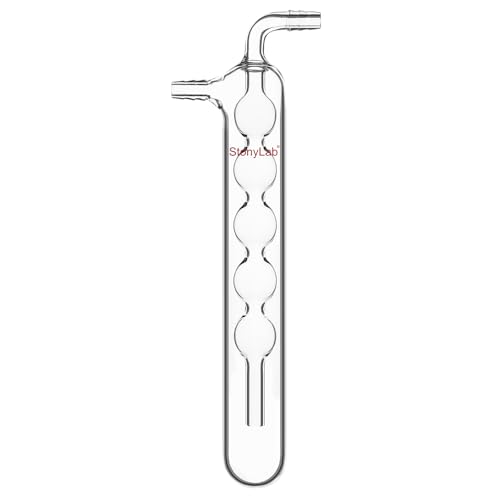
Key specs
- Glass Composition
- G3.3 borosilicate glass
- Immersion Depth
- 225 mm length
Pros:
- G3.3 borosilicate glass composition withstands severe temperature drops in cryogenic baths
- Seamless one-piece construction prevents vacuum leaks along intermediate glass connections
- 225mm condensation length ensures sustained vapor cooling for volatile solvent collection
- 10mm serrated hose connections ensure airtight attachment to standard rubber or silicone lines
Cons:
- Tube-only connection lacks a ground joint for direct modular mounting to glassware assemblies
- Closed glass profile requires repeated solvent flushes to wash out trapped distillates

Key specs
- Condenser Outer Diameter
- 60 mm OD
- Overall Body Length
- 300 mm
Pros:
- Extra-wide 60mm outer diameter maximizes cooling area to condense rapid solvent vapor surges
- 300mm length reaches deep into dewar flasks for prolonged exposure to chilling media
- One-piece borosilicate glass construction eliminates joint leaks under rigorous continuous vacuum
- Thick glass wall fabrication withstands repeated thermal stress and full vacuum pressure
Cons:
- Broad 60mm OD may not fit inside narrow-mouth cryogenic dewars or compact bath flasks
- Hose connection dimensions are unlisted and must be verified prior to fitting your lines
Last update on 2026-10-28 / Affiliate links / Images, Product Titles, and Product Highlights from Amazon Product Advertising API
Does your vacuum trap need a 24/40 ground joint or a serrated hose connection?
Matching your trap to your system depends on whether your setup connects through ground glass joints or flexible vacuum tubing. For rigid glassware lines, confirm whether your manifold requires a 24/40 ground joint or a 24/29 joint. For flexible vacuum lines, check your hose diameter against the listed fittings, such as a 10mm serrated hose connection, a 3/8-inch hose barb, or 1/4-inch ID tubing. Mismatched barb or joint dimensions create vacuum leaks that pull volatile fumes directly into your pump oil and degrade internal seals.
When should you choose a borosilicate glass cold trap over a multi-bottle vacuum setup?
Choose a borosilicate glass cold trap for condensing solvent vapors, and select a multi-bottle plastic setup for collecting liquid biological aspirate. Cold traps made from borosilicate glass or double-wall jacketed glass withstand aggressive organic solvents and low-temperature chilling baths during distillation or evaporation. In contrast, cell aspiration setups rely on vessels like an autoclavable polypropylene 4L bottle paired with a 4L overflow bottle, or bleach-compatible HDPE containers. Exposing plastic collection bottles to harsh organic solvent vapors can soften the polymer, while handling large fluid volumes in a standard glass trap risks overflowing liquid straight into pump seals.
What is the difference between a one-piece and a two-piece glass vacuum trap?
A two-piece glass vacuum trap allows open access for scrubbing condensed residues, whereas a one-piece trap eliminates joint interfaces that could leak under vacuum. A two-piece design, such as a 200mm body with a 24/40 joint and 10mm barbs, separates into two halves so you can reach inside and wash out viscous chemical residues. One-piece borosilicate traps, available in lengths like 200mm, 225 mm, 300mm, or 350mm, remove that joint entirely, eliminating the risk of vacuum grease migrating into the line or ambient air leaking past a ground sleeve. If you regularly run clean solvents that evaporate out easily, a one-piece trap offers dependable vacuum integrity, while heavy distillation residues require the accessibility of a two-piece design.
How do dual-bottle aspiration systems protect vacuum pumps from liquid overflow?
Dual-bottle aspiration systems protect pumps by pairing an initial collection reservoir with a secondary overflow bottle and an inline vent filter. Configurations like a 4L primary bottle with a 4L overflow bottle, or a 2L bottle with a 1L overflow container, catch accidental liquid surges before fluids reach the pump inlet. An inline vent filter provides a final barrier against aerosols, while a secondary container catches spills if a vessel overflows. Unlike dry vacuum collection where people look up how to open the bottom of a vacuum without breaking plastic to empty trapped particles, lab aspiration systems use sealed fluid traps with a 53mm VersaCap and 1/4-inch hose barbs to secure fluids under continuous suction.
How do you clean and sanitize lab vacuum traps after collecting chemical or biological waste?
Sanitizing your vacuum trap depends on its material, requiring autoclaving or chemical disinfection for plastic biohazard bottles and solvent rinsing for borosilicate glassware. Polypropylene trap assemblies and tubing rated as autoclavable can withstand heat sterilization, whereas HDPE bottles with a sealable vent port tolerate bleach solutions for biological decontamination. Borosilicate glass traps require flushing with compatible cleaning solvents or soaking to dissolve stubborn chemical deposits. When inspecting inline vent filters or servicing modular plastic trap housings, knowing how to open a vacuum filter without snapping clips prevents cracking brittle plastic tabs during routine line maintenance.
What dimensions should you confirm to ensure a cold trap fits inside your cooling bath?
Verify both the outer diameter of the glass body and the immersion length below the joint or inlet barbs to make sure the trap fits inside your cooling bath. Glass cold traps feature different body widths, including outer diameter measurements of 30 mm, 55mm O.D., and 60mm O.D. You must also check the immersion depth, such as a 200mm or 225 mm length below the 24/40 joint, or overall lengths ranging from 200mm to 350mm. Confirming these measurements ensures the trap body submerges deeply enough into your cooling bath without bottoming out against the flask floor or straining attached vacuum hoses.