A spec sheet might advertise impressive ultimate vacuum numbers, but the wrong motor can turn a routine filtration run into an agonizing, multi-hour stall. Worse, running an oil-lubricated unit on a clean bench risks venting fine oil mist directly into clean samples and shared room air. Mismatched hose barbs leak under suction, while excessive motor vibration rattles expensive glassware across the counter. Without an integrated regulator, sudden pressure drops can pull volatile solvents past the trap or boil delicate solutions before the cycle finishes.
Daily bench work runs much smoother when your suction stays steady, quiet, and completely oil-free. Dialing in the right setup means choosing an oil-free diaphragm design paired with a flow rate matched to your flask capacity. Single-funnel filtering often needs only a modest stream of ten to fifteen liters per minute, whereas larger setups demand significantly more throughput. Checking for built-in vacuum gauges and dual ports gives immediate control over the draw, while confirming barb dimensions ensures an airtight seal with standard lab tubing. The side-by-side comparison below highlights how capable lab vacuum pumps manage airflow, pressure regulation, and bench stability so every filtration cycle finishes clean.


Comes equipped with rubber tubing to connect directly to bench glassware without immediate adapter purchases.
Key specs
- Operating modes
- Positive and negative pressure
Pros:
- Delivers dual positive and negative pressure modes to handle filtration and basic pressure dispensing from one benchtop unit
- Oil-free diaphragm mechanism prevents oil mist contamination in clean samples and laboratory air
- 15 L/min flow rate provides steady suction for routine liquid filtration setups
- Includes a rubber tube to connect directly to standard filtration glassware out of the box
Cons:
- 15 L/min capacity will run slowly on large-volume liquid batches or multi-branch manifolds
- Does not include an integrated vacuum gauge to monitor exact negative pressure levels

Key specs
- Hose package
- Includes two distinct types of rubber tubes
- Aids quick attachment to varying glassware barbs
- Evacuation rate
- 10 L/min negative pressure
Pros:
- Oil-free diaphragm design keeps sample prep clean without risk of oil vapor backstreaming
- Includes two distinct rubber tube types to fit different glassware barb diameters
- Compact and portable footprint fits neatly next to benchtop Buchner funnels
Cons:
- Limited to negative pressure only, lacking positive pressure output for push dispensing
- 10 L/min flow rate is intended for single funnels and may struggle with viscous mixtures

Oil Free & Maintenance Free: Features on/off switch, no need to unplug the power cord frequently. It can operate without any lubrication, reducing maintenance issues and significantly increasing productionSilence Vacuum Pump: Aluminum alloy silencer reduces the noise generated during use to a greate
Key specs
- High volume flow
- 85 L/min evacuation rate
- Noise dampening
- Fitted with an aluminum silencer to reduce exhaust sound during continuous high-flow benchtop operation.
- Monitoring gauge
- Features a built-in vacuum meter so operators can visually track suction levels without adding external sensors.
Pros:
- High 85 L/min flow rate rapidly pulls vacuum through dense media and multi-port manifolds
- Integrated vacuum meter allows real-time pressure monitoring during sensitive operations
- Built-in aluminum silencer helps suppress motor exhaust noise in shared laboratory rooms
- Includes four connector fittings to accommodate various laboratory and electronics setups
Cons:
- 380W motor draws substantially more benchtop electrical power than compact diaphragm units
- Requires a dedicated 110V outlet and cannot operate on 220V systems without an external converter

Circulates water from a built-in reservoir to generate suction, capturing soluble chemical vapors during filtration runs.
Key specs
- Water reservoir
- 15 L tank capacity
Pros:
- Water circulating design pulls 60 L/min while capturing corrosive vapors before they reach room air
- Generous 15L water reservoir supports sustained operation without rapid fluid heating
- Oil-free operation eliminates the risk of oil mist venting into laboratory spaces
- Well suited for chemistry equipment requiring corrosion-resistant vapor handling
Cons:
- Requires filling, draining, and periodic changing of 15 liters of circulation water
- Bulkier benchtop footprint than standard dry diaphragm filtration pumps

There is a oilless vacuum pump that is easy to install, simple to operate, and high vacuum pump.it is instead of the oil pump in the market , when you get it , only install a silencer at the air outlet, and then install a filter at the air inlet. Plug in the power can use it immediately.Win Outdoor
Key specs
- Two-stage mechanism
- 2-stage oil-free pump
- Mid-range flow rate
- 50 L/min flow capacity
Pros:
- Two-stage diaphragm architecture delivers stable vacuum depth for demanding procedures
- Generous 50 L/min flow rate accelerates medium-to-large liquid filtration procedures
- Oil-free mute construction helps keep shared lab spaces quiet while maintaining clean air
Cons:
- Dedicated 110V configuration cannot plug into 220V circuits directly
- Product listing does not specify included tubing, so barb sizing must be confirmed before purchase

Clean & Oil-Free Operation - An oil-free vacuum pump designed for clean, ultra-low noise, and corrosion-resistant performance. It is perfectly suitable for use with suction filtration assemblies, filtration flasks, vacuum desiccators for rotary evaporators, decompression apparatus, and various other
Key specs
- Dual pressure function
- Features separate ports for positive and negative pressure, enabling both vacuum pull and liquid fractionation.
- Voltage compatibility
- 110V-220V dual voltage
Pros:
- Dual voltage 110-220V capability allows deployment across different lab power environments
- Dual pressure ports support both vacuum filtration and positive pressure fractionation
- Adjustable pressure dial provides control over suction speed to avoid solvent boiling
- Oil-free diaphragm mechanism prevents hydrocarbon contamination of liquid samples
Cons:
- 15 L/min speed is modest for multi-funnel filtration manifolds
- Tubing dimensions are not detailed in the listing and should be checked against existing glassware

Compact housing allows easy transport between shared benches and prep hoods for daily liquid filtration tasks.
Key specs
- Dual pressure function
- Positive and negative ports
Pros:
- Positive and negative pressure ports support both vacuum filtration and positive dispensing
- Oil-free diaphragm construction protects samples from oil vapor backstreaming
- Comes bundled with a rubber tube for direct connection to lab filtration glassware
- Portable benchtop casing allows easy transfer between different workstations
Cons:
- 15 L/min flow rate may prolong filtration times on viscous or particle-heavy liquids
- Lacks a built-in vacuum gauge to confirm precise pressure thresholds

Features variable pressure regulation to match delicate sample needs without collapsing filter membranes.
Key specs
- Evacuation rate
- 30 L/min flow rate
Pros:
- 30 L/min flow rate clears routine filtration runs twice as fast as entry-level 15 L/min pumps
- Dual ports support both negative vacuum pull and positive pressure delivery
- Adjustable pressure mechanism lets users dial in the exact suction level required
- Includes a rubber tube to facilitate fast setup with standard laboratory flasks
Cons:
- Higher cost tier compared to standard 10 L/min and 15 L/min benchtop models
- Pressure adjustment mechanism lacks an integrated dial meter to display numerical vacuum values

Oil Free & Maintenance Free: Upgraded version with on/off switch, no need to unplug the power cord frequently. After connecting the power supply, turn on the switch on the power cord. It can operate without any lubrication, reducing maintenance issues and significantly increasing production180w Sile
Key specs
- Noise dampening
- Equipped with an aluminum silencer to reduce sound output during continuous laboratory operations.
- Connector package
- Four distinct connectors included
- Supports versatile hose attachments
- Integrates with electronics and lab setups
Pros:
- 50 L/min flow rate handles medium-scale vacuum filtration and multi-flask setups
- Built-in vacuum meter gives clear visual feedback on real-time suction levels
- Aluminum silencer keeps exhaust noise lower during extended lab procedures
- Four included connectors provide versatile plumbing options for lab glassware
Cons:
- Lacks dual-pressure capability, operating strictly on negative vacuum pull
- Heavier profile than smaller 10 L/min to 15 L/min diaphragm pumps

Delivers constant negative pressure to keep single-funnel chemical filtration runs steady and predictable.
Key specs
- Single-funnel rate
- 10 L/min flow rate
Pros:
- Maintains constant negative pressure for uniform single-funnel vacuum filtration
- Oil-free diaphragm prevents sample contamination from volatile oil vapors
- Compact, portable body takes up minimal room on crowded analytical lab benches
- Simple plug-and-play operation requires no complex pressure configuration
Cons:
- 10 L/min throughput limits use to small sample volumes and single filter funnels
- Single negative port does not support positive pressure liquid transfer
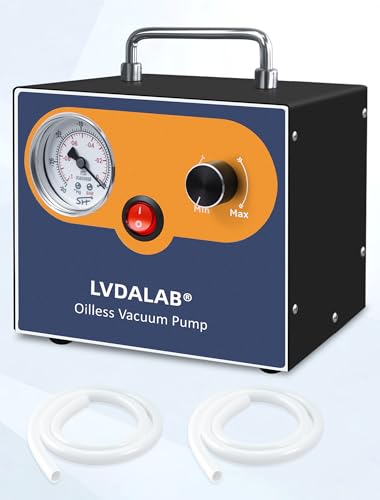
【VARIABLE FLOW CONTROL】---Features adjustable flow function, which can precisely adjust the vacuum level to meet the usage requirements of different scenarios.【PREMIUM MATERIAL】---Designed with CORROSION-RESISTANT components for reliable, long-term operation with minimal wear.【HIGH-PERFORMANCE AND F
Key specs
- Voltage compatibility
- 110V-220V dual range
- Silicone tubing
- Includes two flexible silicone hoses designed for tight seals on laboratory glassware barbs.
Pros:
- 110V-220V voltage compatibility adapts to varying laboratory electrical supplies
- Includes two silicone hoses that resist hardening and provide flexible bench connections
- Adjustable flow mechanism allows fine-tuning for sensitive filtration procedures
- Low-noise oil-free diaphragm protects clean samples without excess bench vibration
Cons:
- 15 L/min flow is not suited for high-throughput multi-branch filtration manifolds
- Does not feature an integrated vacuum gauge for reading real-time negative pressure

Engineered specifically for single-line negative suction, keeping routine vacuum filtration straightforward.
Key specs
- Dedicated negative suction
- 10 L/min vacuum pull
Pros:
- Dedicated negative pressure design tailored specifically for routine laboratory filtration
- Oil-free construction ensures no lubricant fumes enter clean laboratory environments
- Small footprint fits neatly into fume hoods or small prep stations
Cons:
- 10 L/min flow rate can cause sluggish filtration times with dense analytical precipitates
- Package details do not list included tubing, requiring verification of hose barb sizing

Key specs
- Compact power draw
- 12W low-power operation
- Vacuum and pressure limits
- 650 mmHg rated vacuum
- 80 kPa positive pressure limit
- 5 L/min maximum flow rate
Pros:
- Energy-efficient 12W motor minimizes electrical draw on the benchtop
- Broad 110-240V compatibility operates across virtually any international lab power supply
- Dual-function ports provide both 650 mmHg vacuum suction and 80 kPa positive pressure
- Extremely compact form factor fits in cramped workstations or mobile field kits
Cons:
- 5 L/min flow rate is very low and will stall on large-volume liquid filtration tasks
- Unbranded generic unit offers minimal documentation on diaphragm replacement parts
Last update on 2026-10-29 / Affiliate links / Images, Product Titles, and Product Highlights from Amazon Product Advertising API
How many liters per minute of flow do I need for lab vacuum filtration?
Match your flow rate directly to the volume of your samples and the diameter of your filtration funnel. Compact bench setups designed for single-funnel operations, routine sample preparation, or light fractionation typically operate with flow rates of 5 L/min or 10 L/min. Standard laboratory filtration runs and multi-sample work commonly use units delivering 15 L/min or 30 L/min to keep cycle times fast without boiling solvents. For multi-branch manifolds, larger chemistry equipment, or industrial electronics applications, high-capacity models provide 50 L/min, 60 L/min, or up to 85 L/min to maintain constant negative pressure across multiple ports.
Can an oil-free lab diaphragm pump provide both vacuum and positive pressure?
Yes, several oil-free diaphragm pumps feature dual ports designed for both positive pressure and vacuum extraction. Models rated at 5 L/min, 15 L/min, and 30 L/min frequently include separate intake and exhaust fittings, with compact units delivering up to 650 mmHg vacuum alongside 80 kPa of positive pressure. This dual functionality lets you alternate between pulling liquid through a Buchner funnel and providing regulated air pressure for drying or aerating. Other units are engineered exclusively for negative pressure suction at 10 L/min, so check the port labels in the product specifications to confirm whether positive pressure is supported.
What size tubing fits the hose barbs on benchtop lab vacuum pumps?
Tubing fit depends on the specific pump fittings, so you must verify the inner diameter of the barb connectors before attaching your filtration flask. Many portable units include dedicated rubber tubing or silicone hoses in the package, and some models supply 2 types of rubber tubes or 4 distinct connectors to accommodate different glassware setups. Because an improper fit leaks air and drops vacuum pressure, measure the outer diameter of your flask side-arm and confirm the supplied tubing dimensions in the manual to ensure an airtight seal.
How loud are oil-free lab vacuum pumps during continuous operation?
Most oil-free diaphragm pumps operate at low noise levels, but sound and vibration increase with motor size and flow capacity. High-volume pumps rated at 50 L/min and 85 L/min often incorporate an aluminum silencer on the exhaust to minimize air rush, while other designs use medical mute construction to dampen mechanical vibration. Because motor vibration can rattle adjacent glassware on a shared benchtop, check that the pump includes rubber vibration-absorbing feet to prevent movement during filtration runs.
How do I protect an oil-free vacuum pump from liquid and vapor damage?
Always connect an inline moisture trap or liquid collection bottle between your filtration flask and the vacuum intake port. Oil-free diaphragm pumps prevent oil vapor from venting into clean samples, but drawing fluids or condensed solvent vapors into the mechanical chamber will damage the internal valves and diaphragm. While maintenance on consumer appliances might focus on how to open a vacuum filter to dislodge trapped particles, laboratory vacuum pumps rely on external liquid traps because the pumping head is strictly engineered for dry gas and air transfer. Adding a dedicated trap flask keeps accidental overflow from pulling liquid directly into the motor.
When should I choose a water circulating vacuum pump instead of a diaphragm pump?
Choose a water circulating vacuum pump when your workflow involves heavy solvent evaporation or lab chemistry equipment that generates corrosive vapors. Circulating units utilize a built-in reservoir, such as a 15 L water tank providing a 60 L/min circulation flow rate, using fluid movement to generate suction rather than mechanical diaphragms. For general benchtop filtration, degassing, and standard liquid sample prep, an oil-free diaphragm pump rated between 5 L/min and 50 L/min is lighter, easier to relocate, and operates without filling or replacing a water reservoir.