Why do narrow vents and seat seams hold onto dirt no matter how many detailing brushes get ruined trying to reach them? Standard vacuum attachments simply lack the focused velocity to dislodge packed sand, yet grabbing an air tool without checking your compressor often creates a messier headache. Hooking a high-demand cleaning tool to a small tank causes the spinning nozzle to sputter and stall mid-pass, while using a liquid reservoir gun near dashboard switches risks soaking sensitive electronics. Instead of a crisp, clean cabin, that mismatch leaves damp carpet backing, trapped grit pasted in place, and lost weekend hours.
Restoring your vehicle interior should feel straightforward rather than an endless struggle against waterlogged upholstery. A dedicated dry air tool lifts dust out of tight louvers instantly, whereas a one-liter detergent canister injects foaming cleaner directly into stained carpet fibers for fast extraction. Verifying that your home compressor maintains the rated working pressure, typically between 6 and 9.2 bar, keeps the internal mechanism spinning at full speed without bogging down. Looking closely at how car cleaning guns balance liquid output and air volume helps you choose the right setup below, letting you blast away stubborn grit in minutes without risking moisture damage.


Blasts dry dust from vents and buttons without risking moisture damage to car wiring.
Key specs
- Cleaning format
- Dry air blow out
Pros:
- Operates as a dedicated dry blow out tool to clear dust without liquids
- Emits high-pressure airflow to dislodge debris from vents and narrow seams
- Avoids liquid overspray on dashboard buttons and sensitive car electronics
Cons:
- Lacks a fluid reservoir bottle for wet cleaning stained upholstery
- Working pressure and air volume requirements are not specified in the listing

Key specs
- Working pressure
- 6 to 9.2 bar
- Reservoir capacity
- 1L liquid bottle
- Air connection
- 1/4 NPT
Pros:
- 1L liquid reservoir bottle dispenses cleaning solution for deep fabric washing
- Operates at 6 to 9.2 bar working pressure to generate a vortex cleaning action
- Includes 2 nozzle sets for switching between targeted and broad spray patterns
- Connects directly to standard 1/4 NPT air compressor fittings
Cons:
- Requires an air compressor capable of maintaining 6 to 9.2 bar pressure
- Full 1L liquid bottle adds weight during prolonged overhead use

Operates completely dry to clear dirt from consoles without liquid seepage into wiring.
Key specs
- Tool function
- Interior dryer and air blow gun
Pros:
- High-pressure dry air stream lifts trapped sand and crumbs from floor mats
- Interior dryer design speeds up drying times on freshly scrubbed seats
- Lightweight handheld profile allows easy maneuvering around tight pedal boxes
Cons:
- Lacks a cleaning solution bottle for treating fabric stains directly
- Air compressor pressure and volume requirements must be verified before use

Key specs
- Reservoir capacity
- 1L liquid bottle
- Included parts
- Two nozzle sets
- 1L liquid bottle
Pros:
- 1L liquid bottle stores cleaning solution for breaking down ground-in dirt
- Ships with 2 nozzle sets to adapt to both interior and exterior detailing jobs
- High-pressure compressed air design agitates grime on textured door panels
Cons:
- Fluid tank requires careful handling to avoid accidental spills inside the car
- Pressure range in bar or PSI is unlisted and requires verification

Supplied with two nozzles to direct air into vent slats and seams without fluid.
Key specs
- Cleaning format
- Dry air blast
Pros:
- Dry cleaning design prevents saturated upholstery and damp vehicle headliners
- Supplied with 2 interchangeable nozzles to focus air into narrow panel gaps
- Light build reduces wrist fatigue when detailing multiple vehicle interiors
Cons:
- Cannot apply liquid detailing solutions to break down sticky grease
- Specific CFM air volume and working pressure are omitted from the listing
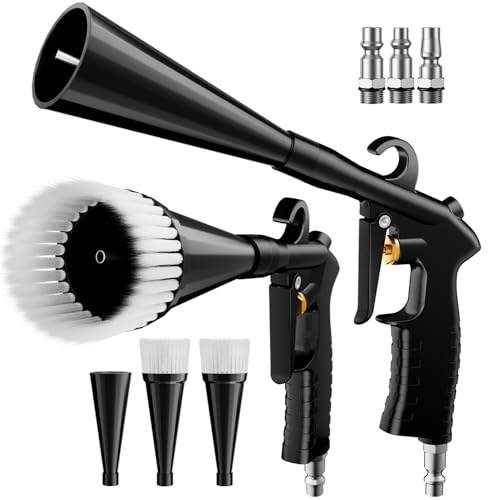
Evaporates moisture from seat fabrics and blows dust out of car vents using compressor air.
Pros:
- Interior dryer air stream helps evaporate trapped water after upholstery cleaning
- High-pressure air output forces buried crumbs out of car seat seams
- Slim gun profile fits into tight spaces under vehicle seat rails
Cons:
- Does not hold cleaning chemicals for washing heavily soiled carpets
- Operating pressure and hose connection sizing must be confirmed on product page

Blasts dry grit from exterior emblems and cabin seams without leaving water spots.
Key specs
- Nozzle configuration
- 2 nozzles included
Pros:
- Includes 2 nozzles to alter air trajectory for interior seams and exterior trim
- Dry blast operation avoids oversaturating headliners and cloth seats
- High-pressure compressed air dislodges grit from window seals and grills
Cons:
- No reservoir bottle for spraying cleaning chemicals or degreasers
- Air compressor CFM rating and minimum operating bar are not detailed

Key specs
- Working pressure
- 6 to 9.2 bar
- Solution volume
- 1L reservoir bottle
Pros:
- Defined 6 to 9.2 bar working pressure helps match air compressor capacity
- 1L reservoir bottle feeds cleaning solution directly into the air stream
- Comes with 2 nozzle sets for flexible interior and exterior car cleaning
Cons:
- Requires an air compressor capable of delivering at least 6 bar pressure
- Operating weight increases when the 1L container is filled with fluid

Key specs
- Airflow purpose
- Dry blowing and surface drying
Pros:
- High-pressure airflow dries wet surfaces and removes dust in one operation
- Dry air process prevents liquid runoff behind dashboard controls
- Streamlined body allows rapid movement between seats and floor pans
Cons:
- Lacks a liquid tank for spraying detergent onto stained floor mats
- Thread size and air pressure limits must be confirmed before connecting

Key specs
- Air mechanism
- Tornado dry air blast
Pros:
- Tornado dry air action spins debris out of tight carpet fibers and vents
- Protects moisture-sensitive car electronics by utilizing only dry air
- Bottle-free design reduces hand strain during extensive vehicle blowouts
Cons:
- Ineffective for deep carpet stain extraction requiring liquid cleaners
- Operating pressure and air compressor compatibility are not provided
Last update on 2026-10-11 / Affiliate links / Images, Product Titles, and Product Highlights from Amazon Product Advertising API
What air pressure is required to operate a car cleaning gun?
A working pressure of 6 to 9.2 bar is required to spin the nozzle mechanism and generate an effective cleaning vortex. Operating below 6 bar produces weak air agitation that leaves grit trapped in seams, while exceeding 9.2 bar risks damaging internal seals and hose fittings. Check your compressor regulator before use to confirm output remains steadily within this 6 to 9.2 bar range.
Will a car cleaning gun run on a standard home air compressor?
It depends on whether your home compressor can supply sustained airflow rather than just meeting peak tank pressure. High-pressure air blow guns draw continuous air volume to maintain rotation, meaning small tank compressors can lose pressure quickly and stall mid-clean. Check your air compressor manual to verify continuous air delivery and ensure the tank can support steady operation at 6 to 9.2 bar.
Should you choose a dry air blow gun or a model with a 1L liquid bottle?
Choose a dry cleaning gun if you primarily want to blow dust out of AC vents, blast sand from carpets, and clean console crevices without introducing moisture. Select a model with a 1L liquid bottle when you want to spray chemical cleaners and shampoo directly into stained floor mats or dirty door sills. If you face stubborn interior spills that air guns cannot break down, pairing air tools with dedicated spot treatments like the best carpet cleaner for red wine helps lift set-in stains before final drying.
Can you safely clean vehicle electronics and headliners with a cleaning gun?
No, you should never spray liquid or direct high-pressure vortex air closely into delicate electronics or headliner fabrics. Moisture from a 1L liquid bottle can seep behind dashboard buttons and damage wiring, while wet spraying on headliners can dissolve adhesive and cause fabric to sag. For dashboards and instrument clusters, use a dry air blow tool held several inches back on reduced pressure to sweep away loose dust safely.
What air hose fitting does a car cleaning gun require?
Most car cleaning guns use a standard 1/4 NPT air inlet connection to pair with detailing hoses. Confirm that your air compressor line features a matching 1/4 NPT quick-connect coupler to prevent air leakage and pressure drops at the handle. Inspect thread seals and quick-connect fittings before pressurizing the tool to ensure consistent airflow during detailing.
Why do some detailing guns include a 2 set nozzle configuration?
A 2 set nozzle system provides both a standard open trumpet for broad air blasts and a brush attachment for mechanical agitation. The bristled nozzle loosens ground-in sand and pet hair from carpet fibers while air sweeps the loosened debris away. Swapping to the standard nozzle allows direct, unobstructed airflow to reach deep into narrow vent louvers and seat rail channels.