
Maintenance packaging promises an effortless, crystal-clear aquatic paradise, but reality often turns into siphoning half your substrate onto a soaked floor while panicked fish dart into hiding. The trouble usually comes down to mismatched equipment. An oversized siphon with uncontrolled suction drains water before lifting debris, or worse, swallows fine sand and risks pulling in small swimmers. Meanwhile, abrasive scrubbers risk permanently gouging acrylic panes or dragging trapped gravel across glass, turning routine maintenance into a cloudy ordeal that leaves murky substrate and scratched tank walls in its wake.
Tank care feels completely different once the gear matches your specific setup. With the right tools, lifting trapped waste and clearing stubborn film takes only minutes without a drop spilling onto your carpet. Getting that smooth routine comes down to matching cleaners to your specific surfaces: look for vacuums equipped with intake guards and flow valves to protect loose sand, choose magnetic scrubbers tailored strictly for glass or acrylic, and stick to fish-safe sprays for outer glass and hoods. The side-by-side comparison below highlights how each option handles different tank setups so you can keep maintenance fast and your fish calm.


CLEANING FUNCTION: Our sand cleaner have four spliced rigid tubes, which can be extended from 11.4 inches to 40.5 inches according to the tank. With brush heads, each corner of the fish tank can be cleaned. Aquarium gravel cleaner can also be used with the duckbill suction port to suck dirt from the
Key specs
- Flow Rate
- 360 GPH
- Power Consumption
- 15W
- Tool Configurations
- 5-in-1 tool set
Pros:
- Delivers a 360 GPH flow rate for rapid water changes and sand washing
- Draws 15W of power to run continuous automatic cleaning functions
- Five-in-one tool setup covers siphoning, filtering, and debris extraction
- Adjustable length adapts the intake tube to different aquarium depths
Cons:
- Electric corded setup requires a nearby outlet and careful cable routing
- The 360 GPH flow rate may create too much turbulence in delicate nano tanks

FUNCTION --- Easy to control, convenient to siphon fish faeces, impurities, turbid water out of fish tank.5 Feet HOSE --- Made from clear & elastic plastic. Makes it more durable and anti-kinking. Harmless to fishes & No peculiar smell.GRAVEL TUBE --- Sinkable, with a detachable filter screen inside
Key specs
- Hose Length
- 5 ft
- Power Source
- Manual gravity siphon
Pros:
- Manual siphon design operates without electricity or cords near open water
- Five-foot hose provides direct reach from the aquarium to a floor bucket
- Straightforward siphon tube cleans gravel and sand without motor impeller jams
Cons:
- Relies entirely on gravity, requiring the drainage bucket to sit below the tank
- Lacks recirculating filtration, requiring manual bucket dumping for dirty water

Key specs
- Cleaner Format
- Double-sided sponge brush
- Reach
- Long-handle manual wand
Pros:
- Long handle keeps hands dry while reaching algae on deep glass panels
- Double-sided sponge brush scrubs light film and stubborn spots without power
- Manual wand creates zero water spill risks outside the aquarium frame
Cons:
- Scrubbing brush does not siphon waste or pull debris from the gravel bed
- Listing leaves acrylic safety unstated, so confirm tank wall compatibility

TETRA WATER CLEANER: Gravel siphon used to easily clean aquariums.COMPATIBLE AQUARIUM SIZE: For aquariums up to 55 gallons.MAKES MONTHLY WATER CHANGES EASY: It only takes 30 minutes to replace 30% of water every 30 days.REMOVE DEBRIS: Siphons are a great way to easily remove debris from gravel by mo
Key specs
- Water Compatibility
- Freshwater aquariums
- Operation Type
- Gravity gravel siphon
Pros:
- Engineered specifically for routine maintenance in freshwater aquariums
- Gravity siphon extracts debris from gravel without disturbing rooted plants
- Non-electric construction removes shock hazards during wet tank maintenance
Cons:
- Hose length is not specified in the listing and should be verified before use
- Formulated for freshwater setups without listed saltwater tank compatibility

Key specs
- Motor Wattage
- 36W
- Attachment Versatility
- 8-in-1 cleaner kit
Pros:
- Equipped with a 36W motor for robust suction through deep substrate beds
- Eight-in-one tool configurations support varied vacuum and water change duties
- Electric pump eliminates manual water suction to start the siphon stream
Cons:
- Higher 36W power draw requires attentive monitoring around smaller fish
- Listing omits hourly GPH flow rating, requiring buyers to verify intake speed

Contains one (1) API SAFE and EASY Aquarium Cleaner Spray 8-Ounce BottleCleans aquarium glass both inside and outside of glass and acrylic aquariums.Cuts through white, crusty mineral deposits.Safe for fish and plants.Use to clean glass or acrylic aquariums.
Key specs
- Bottle Volume
- 8 fl oz
- Application Target
- Formulated for exterior aquarium glass, acrylic, and tank hoods without introducing common household chemical fumes.
Pros:
- Formulated specifically for safe cleaning of aquarium hoods and outer surfaces
- Ready-to-use spray bottle requires no dilution, measuring, or mixing steps
- Compact 8-ounce bottle stores easily inside standard aquarium stands
Cons:
- Intended strictly for external glass and hoods, not for treating tank water
- Eight-ounce container may require frequent reordering on large multi-tank setups

Mufti-functional cleaning kit: Aquarium gravel vacuum cleaner kit is a mufti-functional aquarium cleaner that uses (adopts)the siphon design principle, which includes the aquarium, aquarium sand washing, algae scraping, fish excrement cleaning, aquarium residual debris, and aquarium water changing.
Key specs
- Included Accessories
- Aquarium gravel vacuum
- Aquarium thermometers
- Fish net kit
- Substrate Suitability
- Gravel and sand
Pros:
- Multi-tool kit pairs a gravel vacuum with tank thermometers and a fish net
- Dual-purpose cleaner handles both gravel churning and fine sand washing
- Bundled water-change tools reduce the need to purchase separate accessories
Cons:
- Kit includes multiple loose accessories that require dedicated storage
- Specific pump mechanism and hose dimensions are unlisted and need verification

Key specs
- Wall Compatibility
- Glass and acrylic
- Sizing
- Small
Pros:
- Dual-surface design safely cleans both glass and acrylic aquarium walls
- Magnetic coupling allows glass scrubbing without submerging hands in water
- Small profile maneuvers easily around tight corners and dense tank decor
Cons:
- Small cleaning footprint requires extra passes on larger glass panels
- Does not remove substrate waste, siphon dirty water, or clean gravel beds

Key specs
- Automatic Shutoff
- Timed off feature
- Motor Rating
- 24W
- Modes Available
- 6-in-1 multifunctional
Pros:
- Built-in timed-off setting helps prevent dry-running motor damage
- 24W electric motor powers automatic water changes and sand washing
- Six-in-one modular design handles water circulation, siphoning, and vacuuming
Cons:
- Corded design requires an electrical outlet near the aquarium stand
- Flow rate in GPH is omitted from the listing and should be verified
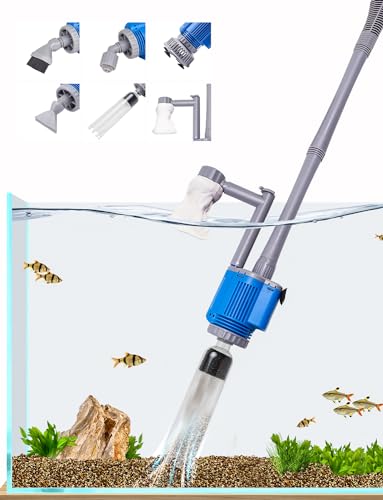
✔【Upgraded 6 In 1 Multifunction Aquarium Gravel Cleaner】The upgraded aquarium gravel vacuum cleaner have 6 in 1 functions with water changer + sand washer + debris cleaning + water filter + water shower + water flow. Suit for freshwater and seawater and various depth fish tank.✔【Strong Power】The 110
Key specs
- Electrical Specifications
- 110V / 28W
- Modular Design
- Removable assembly
Pros:
- Operates on a 110V/28W motor for steady water extraction and debris removal
- Removable modular parts simplify post-cleaning rinse-outs and maintenance
- Multi-function setup handles water changes, sand washing, and algae removal
Cons:
- Standard 110V power cord requires cautious handling around water buckets
- Manufacturer does not list GPH flow speed, so verify intake pull before use
Last update on 2026-10-12 / Affiliate links / Images, Product Titles, and Product Highlights from Amazon Product Advertising API
Should you choose an electric gravel vacuum or a manual siphon?
It depends on whether you need continuous waste filtration or simple gravity-driven water removal. Manual options like a 5-foot siphon hose operate on gravity to drain dirty water into a bucket while pulling waste from freshwater gravel beds. Motorized models with 15W motors delivering 360GPH up to 24W, 28W, or 36W units handle water changes, circulation, and sand washing without requiring manual pumping. If you want multi-function setups that filter waste or pump water across longer distances, verify the motor wattage and check for attachments like 5-in-1, 6-in-1, or 8-in-1 tool kits.
Can magnetic algae scrapers safely clean acrylic tanks without scratching?
Yes, but only if the scraper is explicitly rated for acrylic surfaces. Magnetic cleaners like the Aqueon small scraper are specified for both glass and acrylic, whereas scrapers designed solely for glass can permanently gouge softer acrylic panels. Tools featuring a double-sided sponge brush on a long handle offer another non-abrasive method for reaching tank corners without submerging your arms. Always verify surface compatibility on the product packaging, and ensure no loose gravel gets trapped between the cleaning pad and the wall.
Is a specialized cleaner spray necessary for exterior glass and aquarium hoods?
Yes, because common household glass sprays contain ammonia and harsh detergents that can easily contaminate tank water and harm aquatic life. Specialized formulas like the API Safe & Easy 8-ounce spray are formulated specifically for aquariums to dissolve mineral deposits, salt creep, and grime without leaving toxic residues. For routine care, spray the solution onto an external cleaning cloth rather than directly onto hoods or frames near the water surface.
How do you clean fine sand without sucking it up during a water change?
Choose a gravel vacuum equipped with an intake guard and maintain adequate distance between the nozzle and the sand bed. Vacuums designed for both sand and gravel use screens or filter attachments to separate loose fish waste while keeping denser substrate in the tank. Some cleaning kits also provide fish nets to help you safely move curious fish away from the intake zone before you start siphoning. If fine sand begins rising up the tube, crimp the hose or raise the nozzle to let the heavier grains settle back down.
What motor wattage and voltage should you check for an electric tank cleaner?
Check that the motor wattage matches your tank volume and that the unit runs on standard 110V household power. Electric gravel cleaners range from 15W units rated at 360GPH for moderate tanks up to 24W, 28W, and 36W models designed for faster water changes and high-lift pumping. Higher-wattage motors provide stronger suction through multi-piece tube extensions and sand-washing nozzles. Always verify your tank depth against the cleaner's listed tube length so the motor intake remains submerged at the proper operating level.
How can you prevent messy spills and water damage during manual gravel cleaning?
Secure your discharge hose firmly inside a deep bucket and monitor the drainage rate constantly throughout the water change. A 5-foot siphon hose provides steady flow, but an unsecured hose end can shift under water pressure and soak your floor. Accidental spills from tipped buckets often force tank owners to lift fresh and dried stains from surrounding rugs before dirty water sets. To prevent leaks, fasten the drain tube to your bucket rim with a hose clip and check all manual bulb connections before starting suction.




